Being told that your PAPP-A level is low can be worrying, particularly when the rest of your 12-week screening is reassuring. This guide explains what PAPP-A is, what a low result does and does not mean, and how your pregnancy can be looked after.
Most women with a low PAPP-A result go on to have a healthy pregnancy and a healthy baby.
Key points
- PAPP-A is a protein made by the placenta and measured in your blood at 11–14 weeks.
- A result below about 0.4 MoM is usually described as low.
- Low PAPP-A is a risk marker, not a diagnosis: it is linked with a higher chance of a small baby or pre-eclampsia, but most pregnancies are unaffected.
- The result is best interpreted with your history, blood pressure, uterine artery Doppler and later growth scans.
What is PAPP-A?
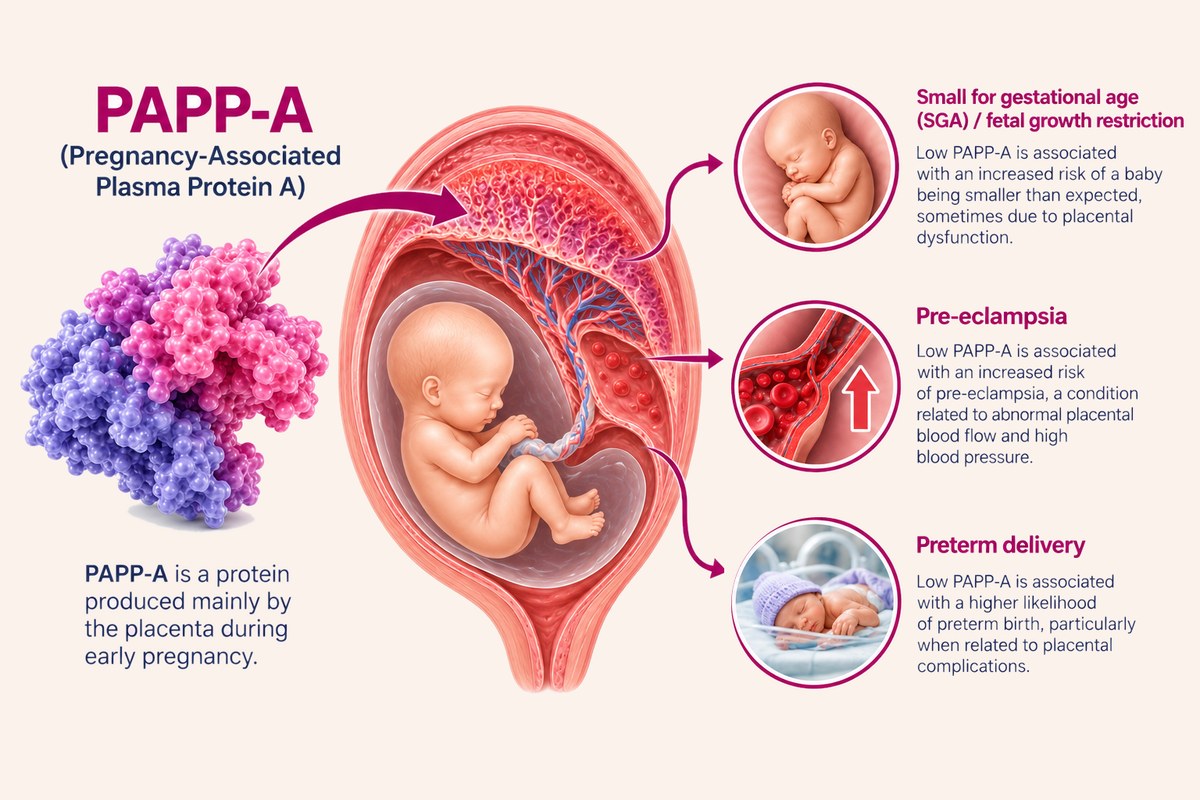
PAPP-A stands for pregnancy-associated plasma protein-A. It is a protein produced mainly by the placenta, and it helps to regulate the growth and development of the placenta and baby. Its level in your blood normally rises as pregnancy progresses.
PAPP-A is measured in a blood test between 11 and 14 weeks, usually as part of the combined screening test. It was introduced to help assess the chance of chromosomal conditions such as Down's syndrome, but research has since shown that a low level is also linked with some complications involving the placenta. Even so, a low PAPP-A result does not mean that your placenta is abnormal or that your baby will have problems.
Why is PAPP-A measured at the 12-week scan?
PAPP-A is one of two blood markers in the combined screening test for Down's, Edwards' and Patau's syndromes; the other is free β-hCG. These are combined with your age and the baby's nuchal translucency to give a chance for each condition.
PAPP-A tends to be lower in pregnancies affected by some chromosomal conditions, but low levels are also common when the baby's chromosomes are normal. When your chromosomal screening result is reassuring, the main importance of a low PAPP-A is its possible link with how the placenta works later in pregnancy.
For further information, read: NIPT vs Combined Screening: Which Test Should I Choose?
What counts as a low PAPP-A result?
PAPP-A is reported as a multiple of the median (MoM). This compares your level with the average (median) for women at the same stage of pregnancy, adjusted for factors such as your weight. A result of 1.0 MoM is exactly average; 0.5 MoM is half the average. In UK practice, a result below about 0.4 MoM (some units use 0.415 MoM) is described as low.
| PAPP-A result | What it generally means |
|---|---|
| 1.0 MoM | Average level |
| 0.5 MoM | Below average, but not classed as low |
| Below about 0.4 MoM | Low PAPP-A |
| Below 0.2 MoM | Very low PAPP-A: other risk factors deserve particular attention |
These thresholds guide monitoring. They do not show whether an individual placenta is working normally.
Does low PAPP-A mean my baby has a chromosomal condition?
No. Low PAPP-A on its own does not mean that your baby has a chromosomal condition; it is only one part of the combined screening calculation. If your combined screening or NIPT result is reassuring, a low PAPP-A does not in itself mean that further genetic testing is needed. Any decision about further tests depends on your overall screening result, the scan findings and your individual circumstances.
Does low PAPP-A mean my placenta is not working properly?
Not necessarily. PAPP-A is not a direct measurement of how the placenta is working. Some pregnancies with low PAPP-A do have differences in placental development or blood flow, but many have a placenta that works perfectly normally throughout pregnancy.
Low PAPP-A is best thought of as a risk marker rather than a sign of placental disease. Its significance becomes clearer when it is considered together with your medical history, blood pressure, uterine artery Doppler and your baby's growth on later scans.
Which complications are linked with low PAPP-A?
A small baby or fetal growth restriction
Fetal growth restriction means that a baby is not reaching its expected growth potential, sometimes because the placenta cannot supply enough oxygen and nutrients. Low PAPP-A increases the chance of this and of having a baby who is small for gestational age, but most babies are not affected.
Pre-eclampsia
Low PAPP-A is linked with a higher chance of pre-eclampsia, but on its own it is a relatively poor predictor. A much more accurate assessment combines your history, blood pressure, uterine artery Doppler and a blood marker of placental function.
For further information, read: Pre-eclampsia Screening at 12 Weeks: Can We Predict and Prevent It?
Preterm birth and stillbirth
Some studies show a link with preterm birth, largely because early delivery may be needed for pre-eclampsia or growth problems; low PAPP-A does not reliably predict spontaneous early labour. Very low PAPP-A has also been linked with a higher relative risk of stillbirth, mainly where there are placental or growth problems, but the absolute risk remains low and most women with low PAPP-A have healthy babies.
What are the actual risks?
It helps to look at the numbers. In published studies, most women with low PAPP-A did not have a small baby or develop pre-eclampsia.
| Outcome | PAPP-A 0.4 MoM or above | PAPP-A below 0.4 MoM | PAPP-A below 0.3 MoM |
|---|---|---|---|
| Baby with birthweight below the 5th centile | 4.7% | 10.6% | 13.3% |
| Pre-eclampsia | 0.2% | 2.3% | Not reported |
Ref: Kirkegaard et al, 2011, Ultrasound Obstet Gynecol; Papamichail et al, 2022, Cureus.
In other words, about 89 in every 100 women with low PAPP-A did not have a baby below the 5th centile, and about 98 in every 100 did not develop pre-eclampsia. The chance of a small baby rises as PAPP-A becomes lower, but even below 0.3 MoM most babies were not small. A baby who is small is also not necessarily growth restricted; some babies are simply constitutionally small and healthy.
Should I take aspirin if my PAPP-A is low?
Low-dose aspirin reduces the risk of preterm pre-eclampsia in women at increased risk. Isolated low PAPP-A is not one of the formal NICE risk factors for aspirin, although some NHS units recommend it as part of their local pathways, particularly when other risk factors are present.
At The Pregnancy Clinic, we do not recommend taking aspirin purely because of an isolated low PAPP-A level. Around 90% of women with low PAPP-A do not have a small baby, so advising aspirin for everyone with a low result would mean treating many women who do not need it.
Instead, we strongly recommend combined screening with a comprehensive risk assessment, including your medical and pregnancy history, blood pressure and uterine artery Doppler, to assess your individual risk of complications related to placental insufficiency. Where this shows an increased risk, we recommend aspirin 150 mg at night, ideally started at 12–13 weeks and before 16 weeks. Aspirin should only be taken on medical advice, particularly if you have an allergy, a bleeding disorder or another contraindication.
Will I need extra scans?
Because low PAPP-A is linked with placental problems, additional scans to monitor your baby's growth are usually recommended. The exact plan depends on local NHS guidance and your individual risk, but a typical approach is:
- 20–22 weeks: a detailed anatomy scan, with uterine artery Doppler where appropriate.
- 28–32 weeks: assessment of the baby's growth, the amniotic fluid and, where appropriate, umbilical artery Doppler.
- 32–36 weeks: further growth assessment, depending on earlier findings.
Uterine artery Doppler measures the resistance to blood flow in the arteries supplying the uterus and placenta. Higher resistance suggests a greater chance of placental complications, although a normal result does not completely exclude them and an abnormal result does not mean they will occur. More frequent scans may be needed if growth slows or the Doppler findings are abnormal.
For further information, read: Uterine Artery Doppler at 12 Weeks: What Is It and Why Is It Important?
If my baby is growing normally, will I need to deliver early?
Normal growth on serial scans, with normal fluid and Doppler findings, is very reassuring, and many women with low PAPP-A have normal scans throughout and deliver healthy babies at term. Low PAPP-A alone does not mean that you need an induction or an early delivery.
The timing of birth depends on your baby's growth, the placenta and your own health. If growth restriction, pre-eclampsia or abnormal Doppler findings develop, closer monitoring or earlier delivery may be recommended, and this is always individualised. Routine antenatal care remains important throughout.
Can I do anything to improve my PAPP-A?
There is no treatment that reliably raises PAPP-A, and the aim of care is not to change the number but to identify and manage any associated risks. This may include assessment for pre-eclampsia, aspirin where indicated, blood pressure checks, growth scans, good management of any existing medical conditions and stopping smoking.
A low PAPP-A result is not caused by anything you have done, and it does not mean that your placenta will work poorly.
How we assess low PAPP-A at The Pregnancy Clinic
We understand that a low PAPP-A result can cause considerable anxiety. Our consultant-led assessment considers the result in the context of your whole pregnancy and may include:
- Review of your first-trimester screening, interpreting the PAPP-A MoM alongside the chromosomal screening result.
- An individualised placental risk assessment, including pre-eclampsia screening, your history and any medical conditions.
- Uterine artery Doppler and detailed scans of your baby's growth and wellbeing.
- A personalised plan for monitoring and preventive treatment, shared with your NHS maternity team.
Most women with isolated low PAPP-A have healthy pregnancies and healthy babies. Our aim is to provide clear information, appropriate reassurance and timely identification of any complications.
Related pregnancy guides
Frequently asked questions
What level of PAPP-A is considered low?
PAPP-A is reported as a multiple of the median (MoM). In UK practice, a result below about 0.4 MoM (or 0.415 MoM in some units) is usually described as low.
Is low PAPP-A a sign of Down's syndrome?
Not on its own. PAPP-A is one part of combined screening, and if your overall combined screening or NIPT result is reassuring, low PAPP-A does not by itself mean further genetic testing is needed.
Will my baby be small if my PAPP-A is low?
The chance is higher, but most babies are not affected. In one large study, about 89 in 100 women with PAPP-A below 0.4 MoM did not have a baby below the 5th birthweight centile.
Do I need aspirin for low PAPP-A?
We do not recommend aspirin purely because of an isolated low PAPP-A, as around 90% of women with low PAPP-A do not have a small baby. Instead, combined screening with a comprehensive risk assessment, including history, blood pressure and uterine artery Doppler, identifies those at increased risk who will benefit from aspirin 150 mg at night from 12–13 weeks, before 16 weeks.
Will I need extra growth scans?
Usually, yes. Growth scans in the third trimester are commonly recommended, with the exact schedule depending on local guidance and your individual risk.
Low PAPP-A assessment at The Pregnancy Clinic
At The Pregnancy Clinic, we offer consultant-led assessments for women with low PAPP-A or concerns about placental function, combining specialist ultrasound, assessment of your baby's growth and an individualised evaluation of your pregnancy risks.
Our aim is to provide reassurance where appropriate, identify any complications at an early stage, and coordinate our recommendations with your NHS maternity team.
Book a specialist pregnancy assessment →This guide provides general information and does not replace advice from your maternity care team. Aspirin should only be taken following appropriate clinical assessment. The Pregnancy Clinic provides planned appointments only; for urgent concerns, please contact your maternity unit, NHS 111 or your GP.
Clinical references
- Akolekar R, Syngelaki A, Poon L, Wright D, Nicolaides KH. Competing risks model in early screening for preeclampsia by biophysical and biochemical markers. Fetal Diagn Ther. 2013;33(1):8–15.
- Mastrodima S, Akolekar R, Yerlikaya G, Tzelepis T, Nicolaides KH. Prediction of stillbirth from biochemical and biophysical markers at 11–13 weeks. Ultrasound Obstet Gynecol. 2016;48(5):613–617.
- Smith GCS, Stenhouse EJ, Crossley JA, Aitken DA, Cameron AD, Connor JM. Early pregnancy levels of pregnancy-associated plasma protein A and the risk of intrauterine growth restriction, premature birth, preeclampsia, and stillbirth. J Clin Endocrinol Metab. 2002;87(4):1762–1767.
- Dugoff L, Hobbins JC, Malone FD, Porter TF, Luthy D, Comstock CH, et al. First-trimester maternal serum PAPP-A and free-beta subunit human chorionic gonadotropin concentrations and nuchal translucency are associated with obstetric complications: a population-based screening study (the FASTER Trial). Am J Obstet Gynecol. 2004;191(4):1446–1451.
- Papamichail M, Fasoulakis Z, Daskalakis G, Theodora M, Rodolakis A, Antsaklis P. Importance of low pregnancy associated plasma protein-A (PAPP-A) levels during the first trimester as a predicting factor for adverse pregnancy outcomes: a prospective cohort study of 2636 pregnant women. Cureus. 2022;14(11):e31256.
- Kirkegaard I, Henriksen TB, Uldbjerg N. Early fetal growth, PAPP-A and free β-hCG in relation to risk of delivering a small-for-gestational age infant. Ultrasound Obstet Gynecol. 2011;37(3):341–347.
- National Institute for Health and Care Excellence. Hypertension in pregnancy: diagnosis and management (NG133).
- NHS England. Saving babies' lives version three: a care bundle for reducing perinatal mortality.
- Royal College of Obstetricians and Gynaecologists. Investigation and care of a small-for-gestational-age fetus and a growth restricted fetus (Green-top Guideline No. 31).
- Fetal Medicine Foundation. First-trimester screening and pregnancy complications.