Genetics · Sevenoaks, Kent
Genetic Carrier Screening
Recommended before pregnancy. A healthier pregnancy starts with knowing your genes.
Most babies are born healthy, and most carriers have no family history of a genetic condition. Carrier screening is a simple blood or saliva test that shows whether you or your partner carry an inherited condition that could be passed on to your children, even when you are both completely healthy.
Testing before you conceive gives you the most time and the widest choice. Our expanded screen covers more than 1,000 genes, with consultant-led advice at every step.
- Recommended before pregnancy
- More than 1,000 genes
- Individuals and couples
Why we recommend testing before pregnancy
Pre-conception screening gives you knowledge, time and choice.
The best time for carrier screening is before you start trying for a baby. Ideally a few months ahead, so results and any partner testing are complete before pregnancy.
The widest choice of options
If you are both carriers of the same condition, options include IVF with PGT-M, donor eggs or sperm, or natural conception with early prenatal diagnosis.
Time to decide calmly
You can think through your results without the time pressure of an ongoing pregnancy.
A healthier start to pregnancy
Plan your pregnancy with specialist input, and arrange the right scans and tests early if they are needed.
Greater peace of mind
Most couples receive reassuring results and can begin their pregnancy with greater confidence.
Already pregnant? Carrier screening is still worthwhile. Test as early as possible, so that diagnostic testing remains an option if it is needed.
What is genetic carrier screening?
Carrier screening examines your DNA to identify genetic variants associated with certain inherited disorders.
Many of these conditions follow an autosomal recessive inheritance pattern. This means that when both partners carry a disease-causing variant in the same gene, there may be a chance of having an affected child.
Other conditions, such as some X-linked disorders, have different inheritance patterns and may be relevant when one partner is a carrier.
Carrier screening can provide important information before conception, when couples have the greatest opportunity to consider their reproductive options.
Who should consider carrier screening?
Couples planning a pregnancy
Understand potential inherited risks before conception, even when there is no known family history of a genetic condition.
Couples undergoing IVF
Consider carrier screening as part of pre-conception assessment and fertility planning, particularly when inherited conditions may influence reproductive decisions.
Individuals with a family history of genetic disorders
If an inherited condition affects your family, targeted genetic testing may be more appropriate than routine carrier screening.
Couples from populations with a higher prevalence of particular inherited conditions
Certain genetic conditions are more common in particular ancestral populations. Personalised screening can help identify relevant risks.
Couples who would like more comprehensive reproductive screening
Expanded carrier screening can assess a wider range of inherited conditions, providing additional information for those who wish to explore their reproductive risks.
What conditions can carrier screening identify?
Depending on the screening panel selected, testing may include conditions such as:
- Cystic fibrosis — an inherited condition affecting the lungs, digestive system and other organs.
- Spinal muscular atrophy (SMA) — an inherited neuromuscular condition affecting muscle strength and movement.
- Thalassaemia and sickle cell disease — inherited blood disorders.
- Fragile X-related conditions — associated with variants in the FMR1 gene, including reproductive and developmental implications.
- Other inherited conditions — selected through broader carrier screening panels based on clinical circumstances and individual preferences.
The exact conditions assessed depend on the laboratory test selected.
What happens if both partners are carriers?
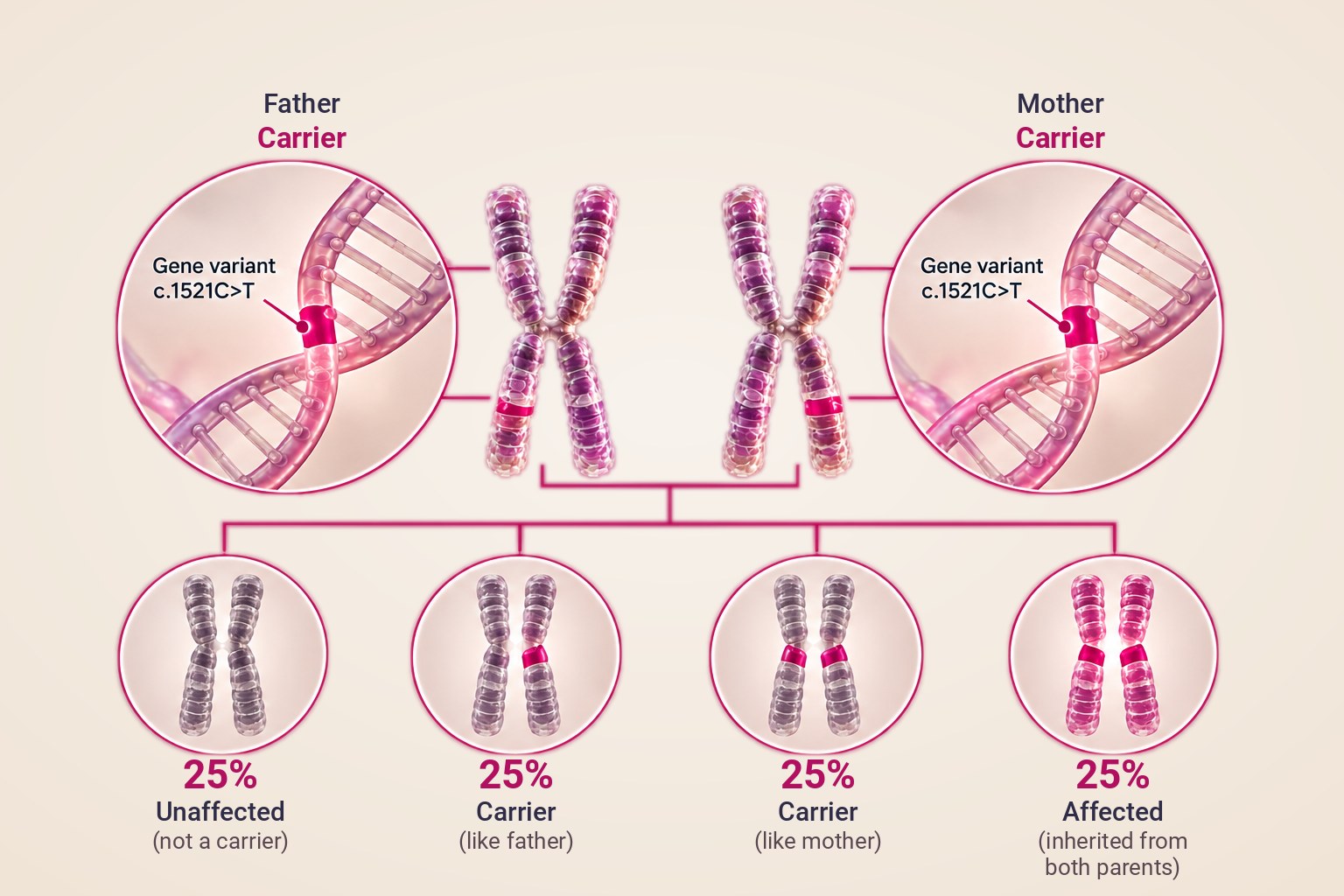
If both partners carry pathogenic variants associated with the same autosomal recessive condition, each pregnancy will generally have:
These probabilities apply separately to each pregnancy.
Where an increased reproductive risk is identified, we can discuss appropriate options, which may include natural conception with prenatal diagnostic testing, IVF with preimplantation genetic testing for monogenic conditions (PGT-M), or other reproductive choices.
Carrier screening options
We will help you choose the most appropriate test.
Targeted Carrier Screening
For patients with a known family history, a specific inherited condition or an established indication for testing.
Examples: targeted familial variants, cystic fibrosis, SMA and haemoglobinopathy testing.
From £560per test
Expanded Carrier Screening
For couples seeking broader reproductive screening across multiple inherited conditions, including more than 1,000 genes.
The exact panel, residual risks and clinical utility are explained before testing.
From £900more than 1,000 genes
Couples planning a pregnancy
A special price is available for partnered reports for pre-conception testing.
Ask us about couple pricing ›Our approach to carrier screening
- 1
Personalised consultation
We review your family history, reproductive plans and any previous genetic investigations.
- 2
Selecting the appropriate test
We explain the available carrier screening options and help you select a clinically appropriate panel.
- 3
Simple sample collection
Testing is usually performed using a blood or saliva sample, depending on the laboratory.
- 4
Expert interpretation
Your results are reviewed and explained in the context of your individual circumstances.
- 5
Planning your next steps
If a relevant genetic variant is identified, we discuss partner testing, reproductive implications and any further specialist assessment required.
Carrier screening: common questions
Do we need carrier screening if there is no family history?
Yes, it is worth considering. Most carriers are healthy and have no family history, because recessive conditions can pass silently through generations before two carrier partners have a child together.
Should both partners be tested?
One partner can be tested first, with the other tested only if a carrier result is found. Testing together as a couple is quicker and gives a combined partnered report. A special couple price is available for pre-conception testing.
Can I have carrier screening during pregnancy?
Yes. Ideally test early in pregnancy, so that results are back in time to consider diagnostic testing such as CVS or amniocentesis if needed.
Does a normal result rule out all genetic conditions?
No. A normal result greatly reduces the chance of the conditions tested, but no screening test can exclude every inherited condition. Carrier screening also does not test for chromosomal conditions such as Down syndrome, which are assessed with NIPT and scans in pregnancy.
What sample is needed?
A blood or saliva sample, depending on the laboratory. We guide you through which panel is right for you before any sample is taken.
Plan your pregnancy with greater understanding
Carrier screening cannot exclude every inherited condition, but it can provide valuable information to support reproductive planning.
At The Pregnancy Clinic, we combine modern genetic investigations with personalised clinical advice, helping you make informed decisions about your future family.
Prefer to speak to us?
Our patient care team is happy to answer your questions and help you choose the right appointment.
01732 647072Call us07572 929888Message us on WhatsAppcare@thepregnancyclinic.comEmail our care teamOpening hoursTuesday 9am–8pm · Thursday 9am–5pm · Saturday 9am–7pm. Other days on request.
Find usThe Highland Suite, Great Hollanden Business Centre, Mill Lane, Underriver, Sevenoaks, Kent TN15 0SQ
Directions and parking →