Chorionic villi are tissues from the placenta (afterbirth). Chorionic villus sampling (CVS) therefore involves taking a small sample from the placenta. Because the placenta develops from the same fertilised egg as the baby, its cells usually carry the same genetic information.
Unlike screening tests, such as combined screening or NIPT, CVS can confirm or rule out a chromosomal condition. It is usually performed between 11 and 14 weeks of pregnancy.
Key points
- CVS is a diagnostic test performed from 11 weeks, usually through the abdomen under ultrasound guidance.
- It is offered after a higher-chance screening result, an abnormal scan finding or when there is a known genetic condition in the family.
- The additional risk of miscarriage from CVS is low, probably below 0.5%, but it depends on the skill and expertise of the operator. With skilled operators, there is no significant increase in procedure-related risk.
- Rapid results (PCR) are available in 2 to 3 days, and detailed genetic testing (karyotype or microarray) in 10 to 14 days.
Why is CVS offered?
- A higher-chance result from combined screening or NIPT.
- A raised nuchal translucency or a structural abnormality on the scan.
- A previous pregnancy affected by a chromosomal or genetic condition.
- Parents who carry a known genetic condition, such as cystic fibrosis, sickle cell disease or a balanced chromosomal rearrangement.
For further information, read: Genetic carrier screening before and during pregnancy
What happens during CVS?
The procedure is performed by a fetal medicine specialist. The actual sampling takes a couple of minutes, and the overall procedure takes about 10 to 15 minutes, within a longer fetal medicine appointment and consultation.
- A detailed scan is performed first to check the baby and the position of the placenta.
- The baby's heartbeat is checked before and after the procedure.
- The skin is cleaned with an antiseptic and a local anaesthetic is used.
- A fine needle is guided through the abdomen into the placenta under continuous ultrasound, and a small sample is taken.
- Most women describe a feeling of pressure or period-like discomfort.
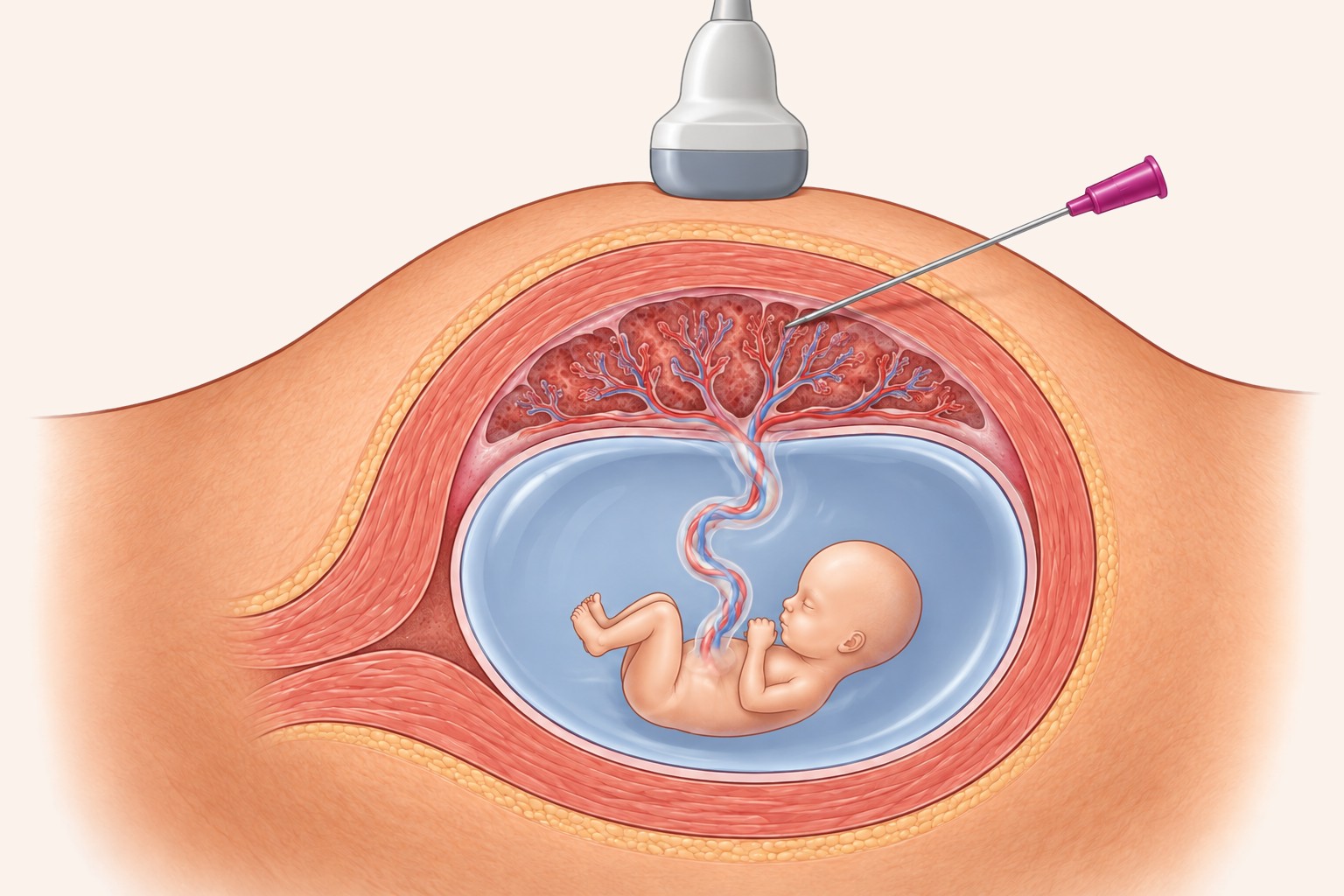 Sampling under ultrasound guidance
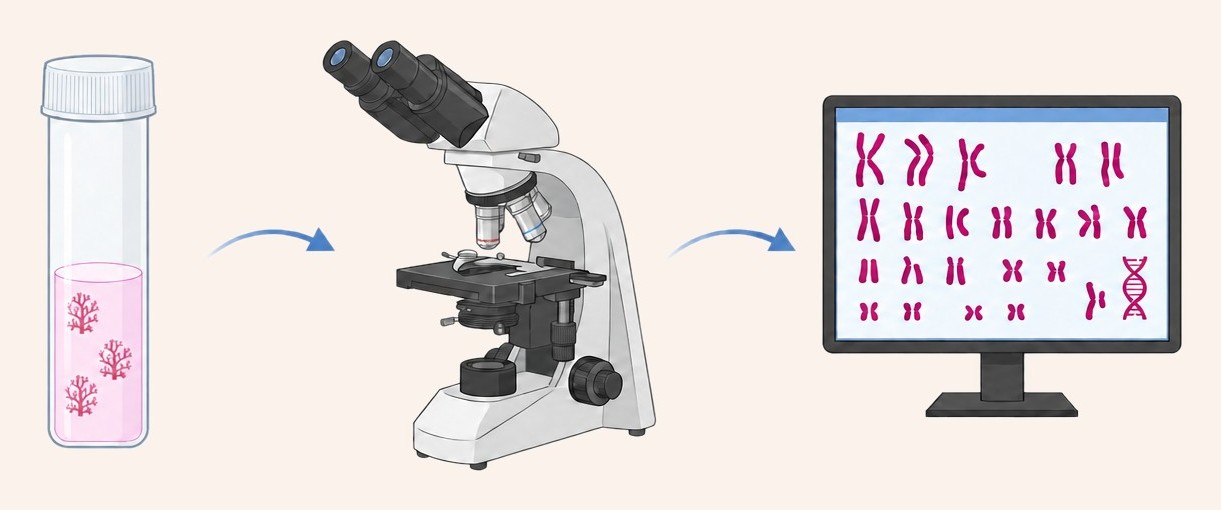 Laboratory testing of the sample
© The Pregnancy Clinic
After the procedure
You may have mild cramping for a few hours. It is usually advised to take things easily for the rest of the day, although strict bed rest is not needed. If your blood group is RhD negative, you will be offered anti-D.
Seek advice urgently if you develop heavy bleeding, severe pain, a fever or leakage of fluid.
What are the risks?
- Miscarriage: the additional risk of miscarriage after CVS is probably below 0.5%, but the risk depends on the operator. When CVS is performed by experienced operators, it does not significantly increase the risk of procedure-related pregnancy loss.
- Infection: serious infection is rare, at less than 1 in 1,000 procedures.
- Repeat test: occasionally the sample is insufficient, or the result is unclear and an amniocentesis is advised.
Results
- Rapid results (QF-PCR) for Down's, Edwards' and Patau's syndromes, and sometimes the sex chromosomes, are usually available within 2 to 3 working days.
- Detailed results, a karyotype or chromosomal microarray, usually take 10 to 14 days. Microarray can detect small missing or extra pieces of chromosomes.
- Specific genetic tests, for a known family condition, may take longer.
- Specialist genetic tests, such as whole exome sequencing, may sometimes be requested if the PCR and microarray results are normal but there are findings that suggest an underlying genetic cause.
Placental mosaicism
In about 1 in 100 CVS samples, the placenta contains a mixture of normal and abnormal cells. Usually the abnormal cells are confined to the placenta and the baby is unaffected. When this happens, an amniocentesis is offered to check the baby's own cells.
CVS or amniocentesis?
The advantage of CVS is that it provides results earlier in pregnancy, so that appropriate management plans can be discussed depending on the findings. CVS is performed from 11 weeks, while amniocentesis is performed from 15 weeks and samples the fluid around the baby. The risks of the two procedures are similar.
If CVS shows placental mosaicism, an amniocentesis is recommended, as it examines cells from the baby rather than the placenta. In pregnancies with a high-chance NIPT result where the 12-week scan shows normal findings, including the NT, anatomy and other markers, amniocentesis can be considered to obtain the baby's own genetic result (fetal genotype) rather than that of the placenta (placental genotype). The choice depends on your gestation, the reason for testing and your preference.
Related pregnancy guides
Frequently asked questions
When can CVS be done?
CVS is usually performed between 11 and 14 weeks of pregnancy, and can be done later if needed.
Is CVS painful?
Most women feel pressure or period-like discomfort, similar to a blood test or injection. A local anaesthetic is used.
What is the miscarriage risk after CVS?
The additional risk of miscarriage after CVS is probably below 0.5%, but it depends on the operator. In experienced hands, CVS does not significantly increase the risk of procedure-related pregnancy loss.
How long do CVS results take?
Rapid results for the common trisomies are usually available within 2 to 3 working days, and detailed results (karyotype or microarray) within 10 to 14 days.
Is CVS more accurate than NIPT?
Yes. CVS is a diagnostic test that confirms whether the baby has a chromosomal condition, whereas NIPT is a screening test.
Can CVS tell the baby's sex?
Yes, the chromosome results show the baby's sex, although CVS is never performed for this reason alone.
Diagnostic testing at The Pregnancy Clinic
If your screening results or scan suggest that diagnostic testing may help, Professor Akolekar will discuss CVS and amniocentesis with you in detail, including the benefits and risks.
CVS is currently not performed at The Pregnancy Clinic. Where testing is recommended, we will arrange a referral to a specialist fetal medicine service and continue to support you through the results.
Explore genetic investigations →The Pregnancy Clinic provides planned appointments only. If you have pain, bleeding or any other urgent concern, please contact your local NHS maternity unit, Early Pregnancy Unit, NHS 111 or your GP.
Clinical references
- Akolekar R, Bower S, Flack N, Bilardo CM, Nicolaides KH. Prediction of miscarriage and stillbirth at 11–13 weeks and the contribution of chorionic villus sampling. Prenat Diagn 2011;31:38–45
- Akolekar R, Beta J, Picciarelli G, Ogilvie C, D'Antonio F. Procedure-related risk of miscarriage following amniocentesis and chorionic villus sampling: a systematic review and meta-analysis. Ultrasound Obstet Gynecol 2015;45:16–26
- Salomon LJ, Sotiriadis A, Wulff CB, Odibo A, Akolekar R. Risk of miscarriage following amniocentesis or chorionic villus sampling: systematic review of literature and updated meta-analysis. Ultrasound Obstet Gynecol 2019;54:442–51
- Beta J, Zhang W, Geris S, Kostiv V, Akolekar R. Procedure-related risk of miscarriage following chorionic villus sampling and amniocentesis. Ultrasound Obstet Gynecol 2019;54:452–7
- RCOG — Amniocentesis and chorionic villus sampling (Green-top Guideline No. 8)
- The Fetal Medicine Foundation
- NHS — Screening for Down's, Edwards' and Patau's syndromes