
Noticing vaginal bleeding during early pregnancy can be frightening, particularly when you have only recently discovered that you are pregnant.
However, bleeding in early pregnancy is relatively common and does not always mean that something is wrong. Many women who experience bleeding go on to have an uncomplicated pregnancy.
There are several possible causes, ranging from minor bleeding from the cervix to conditions that require medical assessment, such as miscarriage or ectopic pregnancy.
Understanding what bleeding may mean, and when to seek help, can make this uncertainty easier to manage.
Key points
- Vaginal bleeding or spotting occurs in approximately one in four pregnancies during the first trimester, although estimates vary between studies.
- Brown discharge usually indicates blood that has been present for some time before leaving the vagina.
- Assessment begins with your pregnancy history, the amount and duration of bleeding, any associated pain and relevant medical or obstetric history.
- When bleeding occurs but ultrasound confirms an intrauterine pregnancy with heart activity, this is generally an encouraging finding.
How common is bleeding in early pregnancy?
Vaginal bleeding or spotting occurs in approximately one in four pregnancies during the first trimester, although estimates vary between studies.
The bleeding may range from a few spots of pink or brown discharge to heavier, period-like bleeding.
Some women experience a single episode, while others have intermittent bleeding over several days or weeks.
The presence of bleeding does not necessarily indicate a miscarriage.
The significance depends on several factors, including the amount of bleeding, whether there is associated pain, how many weeks pregnant you are and the findings on ultrasound.
What are the possible causes of bleeding in early pregnancy?
There are several reasons why vaginal bleeding may occur.
Implantation bleeding
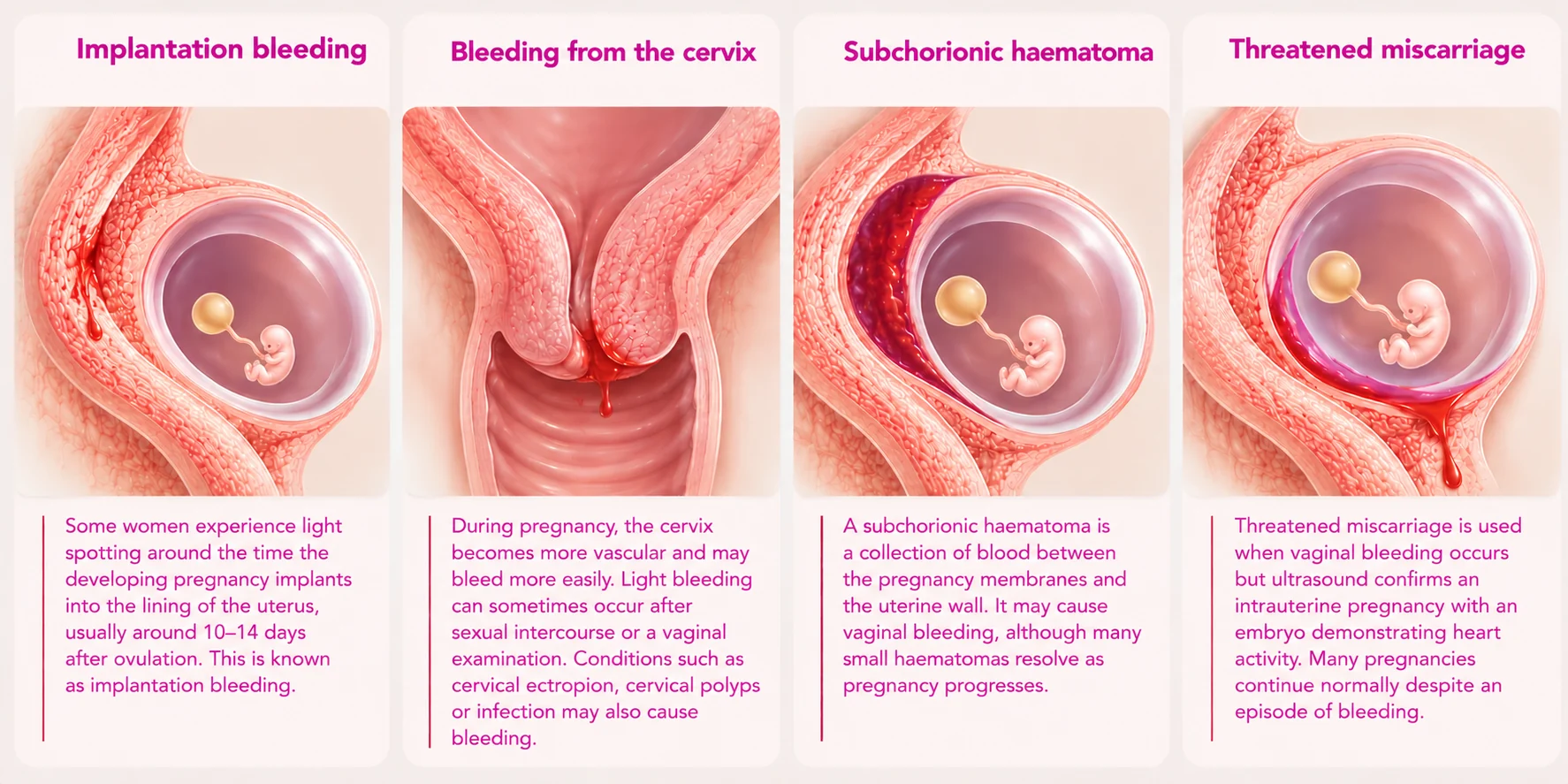
Some women experience light spotting around the time the developing pregnancy implants into the lining of the uterus, usually approximately 10–14 days after ovulation. This is traditionally known as implantation bleeding or Hartman’s sign.
The bleeding is generally light, short-lived and may appear pink or brown. Although this can occur in a normally developing pregnancy, it is not possible to confirm from the bleeding alone that implantation is the cause. Persistent or heavier bleeding, particularly when accompanied by pain, should be assessed.
Bleeding from the cervix
During pregnancy, the cervix becomes more vascular and may bleed more easily. Light bleeding can sometimes occur after sexual intercourse or a vaginal examination.
Conditions such as cervical ectropion, cervical polyps or infection may also cause bleeding.
Subchorionic haematoma
A subchorionic haematoma is a collection of blood between the pregnancy membranes and the uterine wall.
It may be identified during an ultrasound scan, sometimes in women who have experienced vaginal bleeding and occasionally as an incidental finding.
Many small haematomas resolve as pregnancy progresses, although their significance depends on factors such as their size, location and associated symptoms.
For more information, read our guide: Subchorionic Haematoma in Pregnancy: What Does It Mean?
Threatened miscarriage
The term threatened miscarriage is used when vaginal bleeding occurs but ultrasound confirms an intrauterine pregnancy with an embryo demonstrating heart activity.
Many pregnancies continue normally despite an episode of bleeding.
However, the likelihood of subsequent miscarriage depends on the individual circumstances, including the amount of bleeding, associated pain and previous pregnancy history.
Read more: Miscarriage in Early Pregnancy: How Likely Is It and Why Does It Happen?
Miscarriage
Bleeding can sometimes be a sign of early pregnancy loss.
It may be accompanied by abdominal cramps, passage of clots or pregnancy tissue, although symptoms vary considerably.
Importantly, bleeding alone cannot establish the diagnosis of miscarriage. Ultrasound assessment, and occasionally follow-up investigations, may be required.
Ectopic pregnancy
An ectopic pregnancy occurs when a pregnancy develops outside the uterine cavity, most commonly within a fallopian tube.
It may cause vaginal bleeding, abdominal or pelvic pain, or both.
An ectopic pregnancy can sometimes cause serious internal bleeding and requires prompt medical assessment.
Does brown spotting mean something different from red bleeding?
Brown discharge usually indicates blood that has been present for some time before leaving the vagina.
Bright red bleeding generally suggests more recent bleeding.
However, the colour of bleeding alone cannot reliably determine whether a pregnancy is developing normally.
Small amounts of brown spotting can occur in an otherwise healthy pregnancy, but brown discharge can also occur with miscarriage or ectopic pregnancy.
Similarly, fresh red bleeding does not always mean that a miscarriage is occurring.
The amount of bleeding, associated symptoms and ultrasound findings are more informative than colour alone.
Can bleeding occur even when the baby’s heartbeat is normal?
Yes. It is possible to experience vaginal bleeding even when ultrasound demonstrates a normally developing embryo with heart activity.
This can be reassuring, particularly when the embryo’s growth is appropriate for gestational age.
However, identifying heart activity does not guarantee that the pregnancy will continue without complications.
If bleeding persists or becomes heavier, or if abdominal pain develops, further clinical assessment may be necessary.
Read more: When Can You See a Baby’s Heartbeat on an Early Pregnancy Scan?
How is bleeding in early pregnancy investigated?
Assessment begins with your pregnancy history, the amount and duration of bleeding, any associated pain and relevant medical or obstetric history.
An ultrasound scan is often the most useful investigation.
Depending on gestational age and the quality of the images, ultrasound may establish:
- Whether the pregnancy is located within the uterus.
- Whether an embryo and heart activity can be identified.
- Whether pregnancy growth is appropriate for gestational age.
- Whether a subchorionic haematoma or another relevant finding is present.
- Whether there are findings that raise concern about miscarriage or ectopic pregnancy.
At very early gestations, transvaginal ultrasound may provide clearer information than an abdominal scan. It is safe in early pregnancy and does not increase the risk of miscarriage.
Sometimes the ultrasound findings are inconclusive because the pregnancy is too early to assess fully.
If the pregnancy’s location has not been confirmed, further assessment may include serial blood tests measuring the pregnancy hormone β-hCG, together with repeat ultrasound and clinical review.
Blood tests alone cannot reliably establish where a pregnancy is located.
Your clinician should explain the findings and provide a clear follow-up plan.
What happens if the scan shows a normal heartbeat?
When bleeding occurs but ultrasound confirms an intrauterine pregnancy with heart activity, this is generally an encouraging finding.
If you have previously experienced a miscarriage, your clinician may discuss whether progesterone treatment is appropriate.
Under NICE guidance, vaginal micronised progesterone 400 mg twice daily is recommended for women who have vaginal bleeding, a previous miscarriage and an intrauterine pregnancy confirmed by ultrasound. If fetal heart activity is confirmed, treatment is continued until 16 completed weeks of pregnancy.
Progesterone is not routinely recommended for every woman who experiences early pregnancy bleeding.
Treatment decisions should be made following clinical assessment and consideration of your individual history.
Should I rest or avoid exercise if I am bleeding?
It is understandable to want to do everything possible to protect your pregnancy.
However, there is no good evidence that strict bed rest prevents miscarriage in women experiencing early pregnancy bleeding.
You may prefer to reduce strenuous activity while bleeding is ongoing, particularly if you have discomfort, but prolonged bed rest is not routinely recommended.
Your clinician may offer individual advice about exercise, sexual intercourse or work depending on the symptoms, ultrasound findings and any underlying condition.
Most importantly, bleeding should not be assumed to have been caused by something you did or did not do.
When should I seek urgent medical attention?
Although light spotting may not indicate a serious problem, certain symptoms require urgent medical assessment.
Seek urgent assessment if you have:
- Heavy bleeding, particularly if you are soaking sanitary pads rapidly.
- Severe or worsening abdominal or pelvic pain.
- Significant pain affecting one side of the pelvis.
- Shoulder-tip pain.
- Dizziness, fainting or collapse.
- Feeling markedly unwell alongside bleeding.
These symptoms may indicate significant blood loss or an ectopic pregnancy.
If you experience severe pain, collapse or heavy bleeding with symptoms of faintness, call 999 or attend an Emergency Department immediately.
For other bleeding or pain in early pregnancy, contact your local NHS Early Pregnancy Assessment Service, GP or NHS 111 for advice about the appropriate urgency of assessment.
Do not wait for a routine private scan if you have symptoms that require urgent investigation.
Understanding bleeding in early pregnancy
Bleeding during the first trimester is common, and many women who experience spotting or bleeding go on to have a healthy pregnancy.
However, bleeding can sometimes be associated with miscarriage, ectopic pregnancy or other complications.
The most important consideration is not simply whether bleeding has occurred, but what is causing it and whether the pregnancy is developing normally.
A careful clinical assessment, supported by ultrasound when appropriate, can help establish the cause and determine whether any further investigations or follow-up are necessary.
Related pregnancy guides
Frequently asked questions
How common is bleeding in early pregnancy?
Vaginal bleeding or spotting occurs in approximately one in four pregnancies during the first trimester, although estimates vary between studies.
What are the possible causes of bleeding in early pregnancy?
There are several reasons why vaginal bleeding may occur. Some women experience light spotting around the time the developing pregnancy implants into the lining of the uterus, usually approximately 10–14 days after ovulation.
Does brown spotting mean something different from red bleeding?
Brown discharge usually indicates blood that has been present for some time before leaving the vagina.
Can bleeding occur even when the baby’s heartbeat is normal?
Yes. It is possible to experience vaginal bleeding even when ultrasound demonstrates a normally developing embryo with heart activity.
How is bleeding in early pregnancy investigated?
Assessment begins with your pregnancy history, the amount and duration of bleeding, any associated pain and relevant medical or obstetric history.
What happens if the scan shows a normal heartbeat?
When bleeding occurs but ultrasound confirms an intrauterine pregnancy with heart activity, this is generally an encouraging finding.
Early pregnancy care at The Pregnancy Clinic
At The Pregnancy Clinic, early pregnancy ultrasound examinations are provided as part of a consultant-led pregnancy and fetal medicine service.
We assess your ultrasound findings alongside your symptoms, pregnancy history and individual circumstances, providing clear explanations and appropriate recommendations for further assessment when needed.
Book an early pregnancy scan →The Pregnancy Clinic is not an emergency service. If you experience severe pain, heavy bleeding, fainting or other acute symptoms, please seek urgent NHS assessment.