
The 20-week anomaly scan checks your baby's development, and it also looks at where the placenta is attached in the womb. Being told that your placenta is "low-lying" is common at this scan, and in most women the placenta will no longer be low by the third trimester.
This guide explains what a low-lying placenta and placenta praevia are, why they are identified at the 20-week scan, how they are followed up, and what they mean for the rest of your pregnancy.
Key points
- A low-lying placenta is a relatively common finding at the 20-week anomaly scan, seen in about 1 in 10 pregnancies.
- About 9 out of 10 women with a low-lying placenta at 20 weeks will no longer have a low-lying placenta later in pregnancy.
- The chance of resolution depends on the exact placental position, its distance from the cervix and whether you have had previous uterine surgery.
- Most women with a low-lying placenta at 20 weeks have uncomplicated pregnancies.
- If the placenta remains low-lying or covers the cervix in the third trimester, additional monitoring and individualised delivery planning are important.
- Any vaginal bleeding should prompt immediate contact with your maternity assessment unit.
What is a low-lying placenta?
The placenta is an organ that develops during pregnancy and provides oxygen and nutrients to your baby through the umbilical cord.
It normally attaches to the wall of the womb (uterus), either at the front (anterior), the back (posterior), the upper part of the uterus (fundus) or, at times, to the sides (lateral).
The uterus has an upper part (upper segment) and a lower part (lower segment). The lower segment leads to the neck of the womb (cervix). The cervix is the narrow lower part of the uterus that opens into the vagina.
In the majority of pregnancies, the placenta is attached to the upper segment and is away from the cervix. Sometimes, the placenta develops in the lower part of the uterus, close to the cervix. When the placenta is close to the cervix, it is described as a low-lying placenta.
A low-lying placenta is relatively common at the 20-week anomaly scan. As pregnancy advances, the placenta appears to move upwards. Therefore, in most women with a low-lying placenta at the 20-week scan, the placenta is no longer low-lying and close to the cervix by the third trimester, because it has moved up and further away from the cervix.
Being told that you have a low-lying placenta at 20 weeks does not mean that you will necessarily have complications or need a caesarean section.
What is placenta praevia?
Praevia is a Latin word meaning "in front of". Placenta praevia therefore refers to a condition in which the placenta is in front of the neck of the womb (cervix) and is covering it.
The cervix has an inside opening towards the uterus called the internal os and an outside opening towards the vagina called the external os. Placenta praevia is defined as a placenta covering the internal os of the cervix.
What is the difference between a low-lying placenta and placenta praevia?
The distinction depends on the relationship between the lower edge of the placenta and the internal os of the cervix.
Placenta praevia is a more serious form of low-lying placenta. All placentas that are praevia are low-lying, i.e. close to the cervix, but not all low-lying placentas are praevia. In terms of definition:
- Low-lying placenta: the placental edge is less than 20 mm from the internal cervical os but does not cover it.
- Placenta praevia: the placenta lies directly over the internal cervical os, partially or completely covering the opening.
This distinction is important because a placenta covering the cervix can obstruct the baby's passage during vaginal birth and carries a greater risk of bleeding.
| Placental position | Ultrasound finding | Clinical significance |
|---|---|---|
| Normally located placenta | Placental edge at least 20 mm from the internal cervical os | Usually no concern about placental position |
| Low-lying placenta | Placental edge less than 20 mm from, but not covering, the internal cervical os | Requires reassessment later in pregnancy |
| Placenta praevia | Placenta covers the internal cervical os | Increased bleeding risk; usually requires caesarean delivery if it persists |
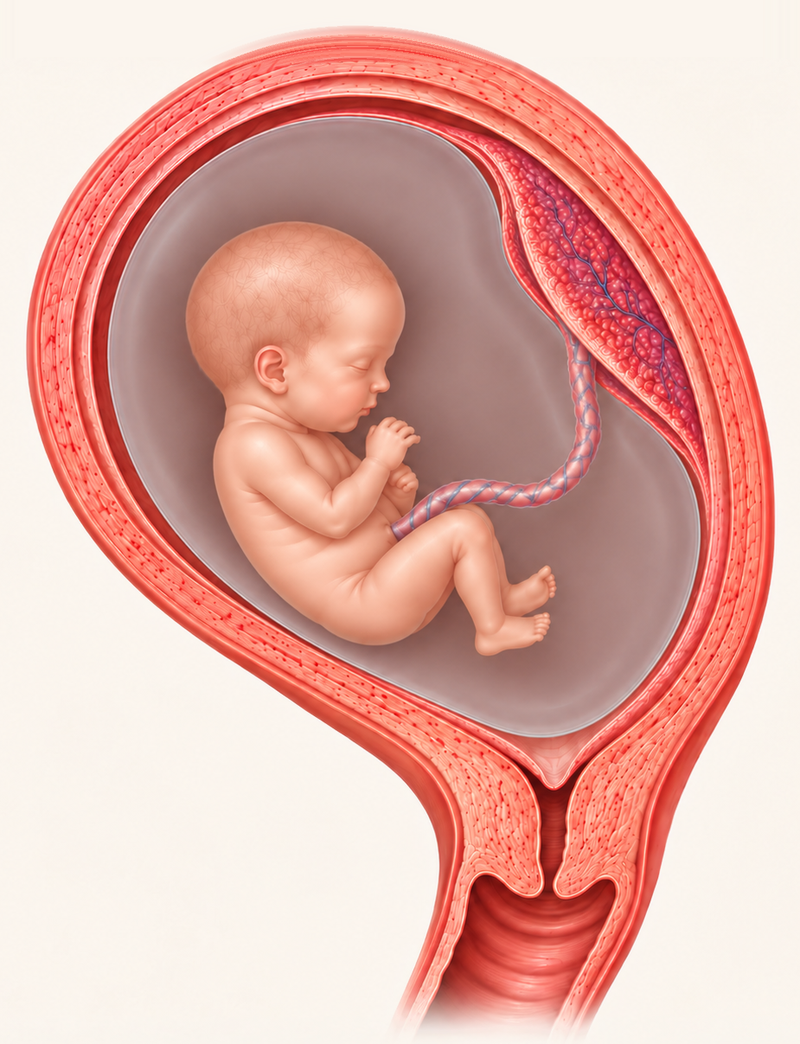
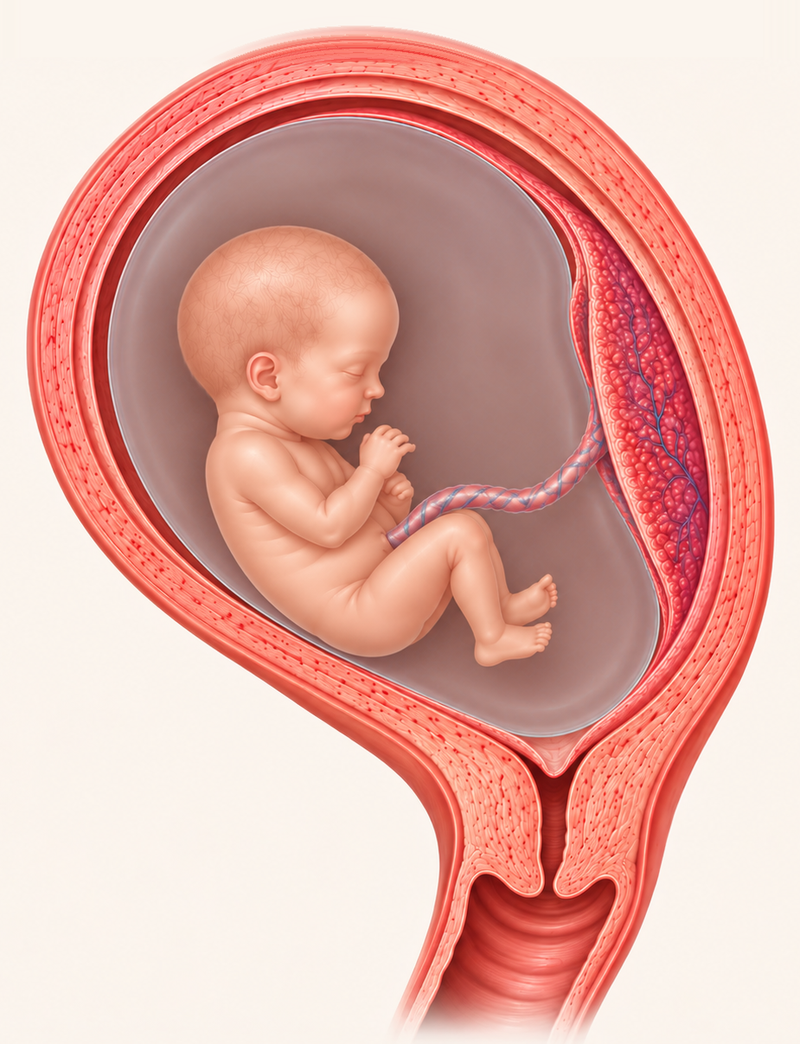
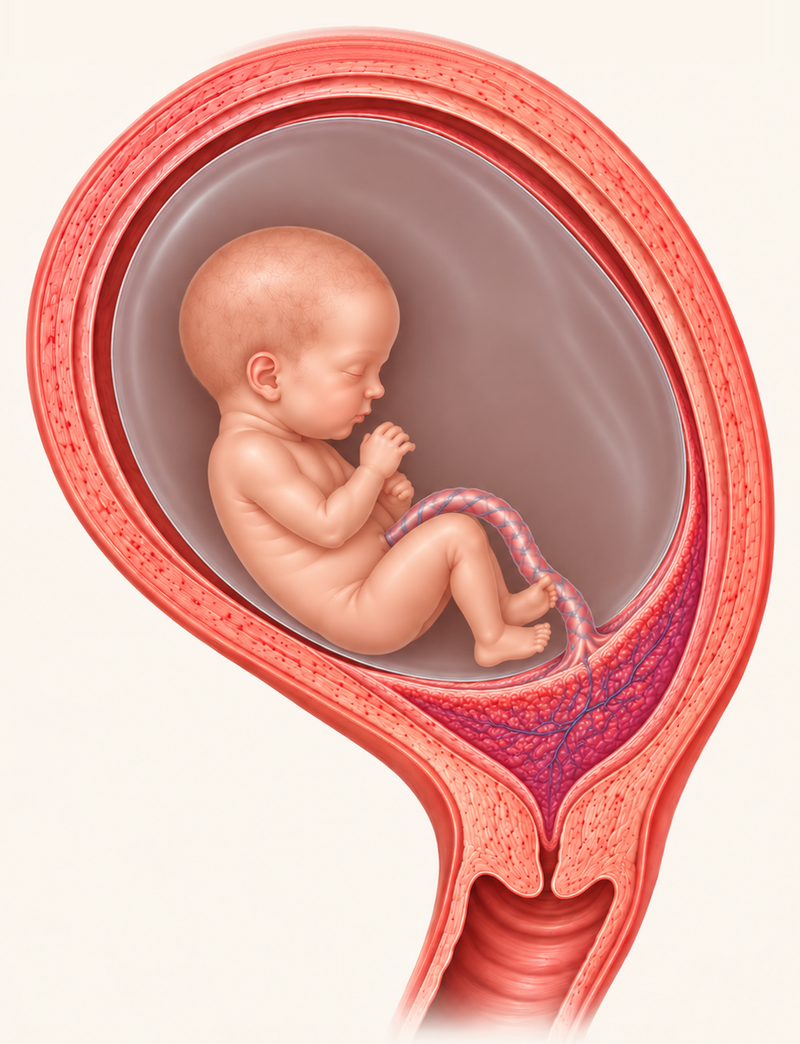
© The Pregnancy Clinic
How common is a low-lying placenta at 20 weeks?
Approximately 1 in 10 pregnancies (10%) have a low-lying placenta identified at the routine mid-pregnancy ultrasound scan.
However, most resolve as pregnancy progresses. In approximately 9 out of 10 women with a low-lying placenta at the 20-week scan, the placenta will have moved upwards, further away from the internal os, and will no longer be low-lying at the follow-up scan in the third trimester.
The likelihood of resolution depends on several factors, including how close the placenta is to the cervix, whether it covers the internal os, its position on the uterine wall and whether you have previously had a caesarean section.
Why does the placenta appear to move upwards during pregnancy?
The placenta does not physically move or migrate around the uterus. Instead, the apparent change in placental position occurs because the uterus grows and stretches during pregnancy.
As the lower part of the uterus develops, the distance between the placental edge and the cervix often increases. This process is sometimes called placental migration, although the placenta itself remains attached to the same general region of the uterine wall. The effect is particularly noticeable during the second and third trimesters.
Consequently, a placenta that appears close to the cervix at 20 weeks may be well away from it by 32–36 weeks.
However, a placenta that covers the internal cervical os, particularly with substantial overlap, is less likely to resolve than one that is merely close to the cervix.
How is a low-lying placenta diagnosed?
Placental position is routinely assessed during the 20-week anomaly scan.
Initially, the placenta is examined using a transabdominal ultrasound scan (a scan through the tummy), with the probe placed on your abdomen. If the placenta appears close to the cervix, a transvaginal ultrasound scan should be carried out, as it is generally more accurate than the abdominal scan for measuring the distance between the placenta and the internal os of the cervix.
During this examination, a narrow ultrasound probe is gently inserted into the vagina to obtain a clearer view of the cervix and the lower edge of the placenta.
Transvaginal ultrasound is safe in pregnancies with a low-lying placenta or placenta praevia and does not cause any harm when performed appropriately.
When will I need another ultrasound scan?
If a low-lying placenta or placenta praevia is identified at the 20-week scan, a follow-up ultrasound scan is usually recommended at approximately 32 weeks. The purpose is to reassess the position of the placenta in relation to the cervix.
If the placenta remains low-lying at 32 weeks, a further scan is commonly arranged at approximately 36 weeks.
| Stage of pregnancy | Purpose of the ultrasound scan |
|---|---|
| 20–22 weeks | Identify placental position and measure the distance from the internal os |
| About 32 weeks | Assess whether the placenta remains low-lying |
| About 36 weeks | Reassess a persistently low placenta and help plan delivery |
Additional scans may be necessary if there is vaginal bleeding or another clinical concern.
In women who have had a previous caesarean delivery and have an anterior low-lying placenta or placenta praevia, earlier specialist assessment may be required to evaluate the possibility of placenta accreta spectrum.
What are the risks associated with a low-lying placenta?
The main concern with a low-lying placenta or placenta praevia is vaginal bleeding, particularly during the second half of pregnancy.
As the lower part of the uterus stretches and the cervix begins to change, the attachment between the placenta and the uterine wall may be disrupted. This can cause bleeding, which may occasionally be heavy.
Placenta praevia carries a greater risk of significant bleeding than a placenta that is low-lying but does not cover the cervix. Potential complications include:
- Vaginal bleeding during pregnancy.
- Hospital admission for observation or treatment.
- Preterm birth, sometimes because early delivery becomes necessary.
- An increased likelihood of caesarean delivery.
- Heavy bleeding during or after delivery.
However, many women with a low-lying placenta at 20 weeks experience no bleeding or other complications. The overall risk depends on whether the placenta remains low-lying later in pregnancy.
What should I do if I experience vaginal bleeding?
Vaginal bleeding in a pregnancy with a low-lying placenta or placenta praevia should always be taken seriously. Bleeding may occur without pain and can sometimes be substantial.
If you experience any vaginal bleeding, contact your NHS maternity assessment unit immediately, even if the bleeding is light or stops on its own.
If bleeding is heavy, you feel faint or unwell, or you have severe abdominal pain, seek emergency medical help by calling 999. Do not wait for a routine ultrasound appointment.
Your maternity team may recommend assessment, an ultrasound scan, monitoring or hospital admission depending on the circumstances.
Can I exercise, have sex or travel with a low-lying placenta?
This is a common concern after the 20-week scan.
For women with a low-lying placenta found at a routine scan who have had no bleeding, there is limited evidence that routinely restricting physical activity improves pregnancy outcomes. However, advice should be individualised according to the placental position, any history of bleeding and other pregnancy risk factors.
Exercise
Gentle physical activity may be appropriate for women with a low-lying placenta and no symptoms, but strenuous or high-impact activities may need individual discussion, depending on the specific findings. Routine bed rest is not recommended simply because a placenta is low-lying.
Sexual intercourse
There is limited evidence that avoiding intercourse prevents bleeding in every woman with a low-lying placenta. However, your doctor may recommend avoiding penetrative intercourse if you have placenta praevia, particularly if bleeding has occurred. If vaginal bleeding develops, intercourse should be avoided until you have been assessed and advised by your maternity team.
Travel and flying
A low-lying placenta at 20 weeks does not automatically mean that flying is unsafe. However, travel planning should take into account the placental position, whether bleeding has occurred, the stage of pregnancy and access to emergency maternity care. Women with placenta praevia or a history of bleeding may be advised against travel to places where emergency maternity care is difficult to access.
Will I need a caesarean section?
Not necessarily.
If the placenta is no longer low-lying later in pregnancy, vaginal birth is usually possible, unless there is another obstetric reason for a caesarean birth.
If the placental edge remains less than 20 mm from the internal os at 36 weeks, or the placenta covers the internal os, a caesarean delivery is usually recommended. For placenta praevia, a planned caesarean is usually carried out between 36+0 and 37+0 weeks. For a low-lying placenta that does not cover the cervix, it is usually carried out between 37+0 and 38+0 weeks. The exact timing depends on individual circumstances, clinical findings and local guidance.
What is placenta accreta spectrum, and should I be concerned?
Placenta accreta spectrum (PAS) describes a group of conditions in which the placenta attaches abnormally firmly to, or grows into, the muscular wall of the uterus.
The risk is particularly increased when a placenta is low-lying or covers the cervix in a woman who has previously had a caesarean section. This is because the placenta may implant over an area of uterine scarring. The risk generally increases with the number of previous caesarean deliveries.
However, most women with a low-lying placenta do not have placenta accreta spectrum.
If you have had a previous caesarean section and the placenta is anterior and low-lying or praevia, a targeted ultrasound assessment is recommended to look for features of abnormal placental attachment.
Where PAS is suspected, referral to a specialist multidisciplinary team is important for planning pregnancy care and delivery.
How does The Pregnancy Clinic assess a low-lying placenta?
At The Pregnancy Clinic, we provide consultant-led ultrasound assessment for women who have been told that their placenta is low-lying or covering the cervix.
Our approach focuses on accurately determining placental position, assessing relevant risk factors and providing clear advice about pregnancy monitoring and delivery planning. A specialist assessment may include:
- Detailed placental ultrasound: assessment of whether the placenta is anterior, posterior or covering the cervix.
- Transvaginal ultrasound: accurate measurement of the distance between the placental edge and the internal cervical os, when indicated.
- Colour Doppler assessment: evaluation of the blood vessels of the placenta and lower part of the uterus, where clinically appropriate.
- Assessment of placenta accreta spectrum risk: particularly in women with a previous caesarean delivery or uterine surgery.
- Individualised pregnancy planning: advice about follow-up scans, bleeding precautions and travel, coordinated with your NHS maternity team.
Our aim is to provide reassurance where appropriate, while identifying pregnancies that may need additional specialist care.
Related pregnancy guides
Frequently asked questions
Will a low-lying placenta at 20 weeks move up?
In most cases, yes. About 9 out of 10 low-lying placentas seen at the 20-week scan are no longer low-lying by the third trimester, as the lower part of the womb grows and stretches.
What is the difference between a low-lying placenta and placenta praevia?
A low-lying placenta has its edge less than 20 mm from the internal os of the cervix but does not cover it. Placenta praevia covers the internal os, partially or completely, and carries a greater risk of bleeding.
When will my placenta be checked again?
A follow-up scan is usually recommended at about 32 weeks. If the placenta is still low-lying, a further scan is commonly arranged at about 36 weeks to help plan delivery.
Will I need a caesarean section?
Not necessarily. If the placenta is no longer low-lying later in pregnancy, vaginal birth is usually possible. A caesarean is usually recommended if the placenta remains less than 20 mm from the internal os at 36 weeks or covers it.
What should I do if I have bleeding?
Contact your NHS maternity assessment unit immediately, even if the bleeding is light or has stopped. If bleeding is heavy, or you feel faint or unwell, call 999.
Specialist placental ultrasound at The Pregnancy Clinic
At The Pregnancy Clinic, we offer consultant-led ultrasound examinations for women with a low-lying placenta, placenta praevia and concerns about placental position or attachment.
Our specialist assessments provide accurate placental measurements, individualised risk evaluation and clear recommendations for ongoing pregnancy care, coordinated with your NHS maternity team.
Book a specialist placental ultrasound →This guide provides general information and does not replace advice from your maternity care team. If you experience vaginal bleeding, seek immediate assessment through your NHS maternity service. The Pregnancy Clinic provides planned appointments only; for urgent concerns, please contact your maternity unit, NHS 111 or your GP.
Clinical references
- National Institute for Health and Care Excellence (NICE). Antenatal care. NICE guideline NG201. 2021.
- Jauniaux ERM, Alfirevic Z, Bhide AG, et al. Placenta praevia and placenta accreta: diagnosis and management. Green-top Guideline No. 27a. BJOG. 2019;126(1):e1–e48.
- Jansen CHJR, de Mooij YM, Blomaard CM, et al. Follow-up ultrasound in second-trimester low-positioned anterior and posterior placentae: prospective cohort study. BJOG. 2020;127:1199–1207.
- Jauniaux E, Bhide A, Kennedy A, et al. FIGO consensus guidelines on placenta accreta spectrum disorders: prenatal diagnosis and screening. Int J Gynaecol Obstet. 2018;140(3):274–280.
- NHS England. Saving Babies' Lives Care Bundle, Version 3. 2023.