Finding out that your baby is breech late in pregnancy can be unsettling, particularly if you were hoping for a straightforward birth. The good news is that many breech babies turn head down on their own, and there are safe, well-tested options if your baby stays breech.
This guide explains what breech means, how likely your baby is to turn, what is involved in each option and what the research, including our own studies, tells us, so that you can make the choice that is right for you.
Key points
- A baby is breech when it is lying bottom or feet first, instead of head first.
- About 6 in 100 babies are not head down at the 36-week scan. In our study of more than 100,000 pregnancies, more than 4 in 10 of these babies were head down by the time they were born.
- External cephalic version (ECV) is a procedure to gently turn your baby by pressing on your tummy. It works in about half of women and can avoid the need for a caesarean birth.
- If your baby stays breech, the options are a planned caesarean birth, usually at or after 39 weeks, or a planned vaginal breech birth in a hospital with an experienced team.
- A planned caesarean birth carries a lower risk for the baby around the time of birth than a planned vaginal breech birth, but it carries the risks of an operation for you and for future pregnancies.
- There is not enough evidence that positions, exercises, acupuncture, acupressure or moxibustion help a breech baby to turn.
- A scan at 36 weeks confirms your baby’s position and checks the placenta, fluid and growth, which helps you and your maternity team choose the right option.
What does breech mean?
Most babies settle head down (cephalic) by the end of pregnancy, ready to be born head first. A baby is breech when the bottom or feet are lowest in the womb. There are three main types:
- frank (extended) breech, the most common type, where the baby’s bottom is lowest, with the legs pointing straight up and the feet near the face
- complete (flexed) breech, where the baby is sitting cross-legged, with the knees bent and the feet near the bottom
- footling breech, where one or both feet are below the bottom.
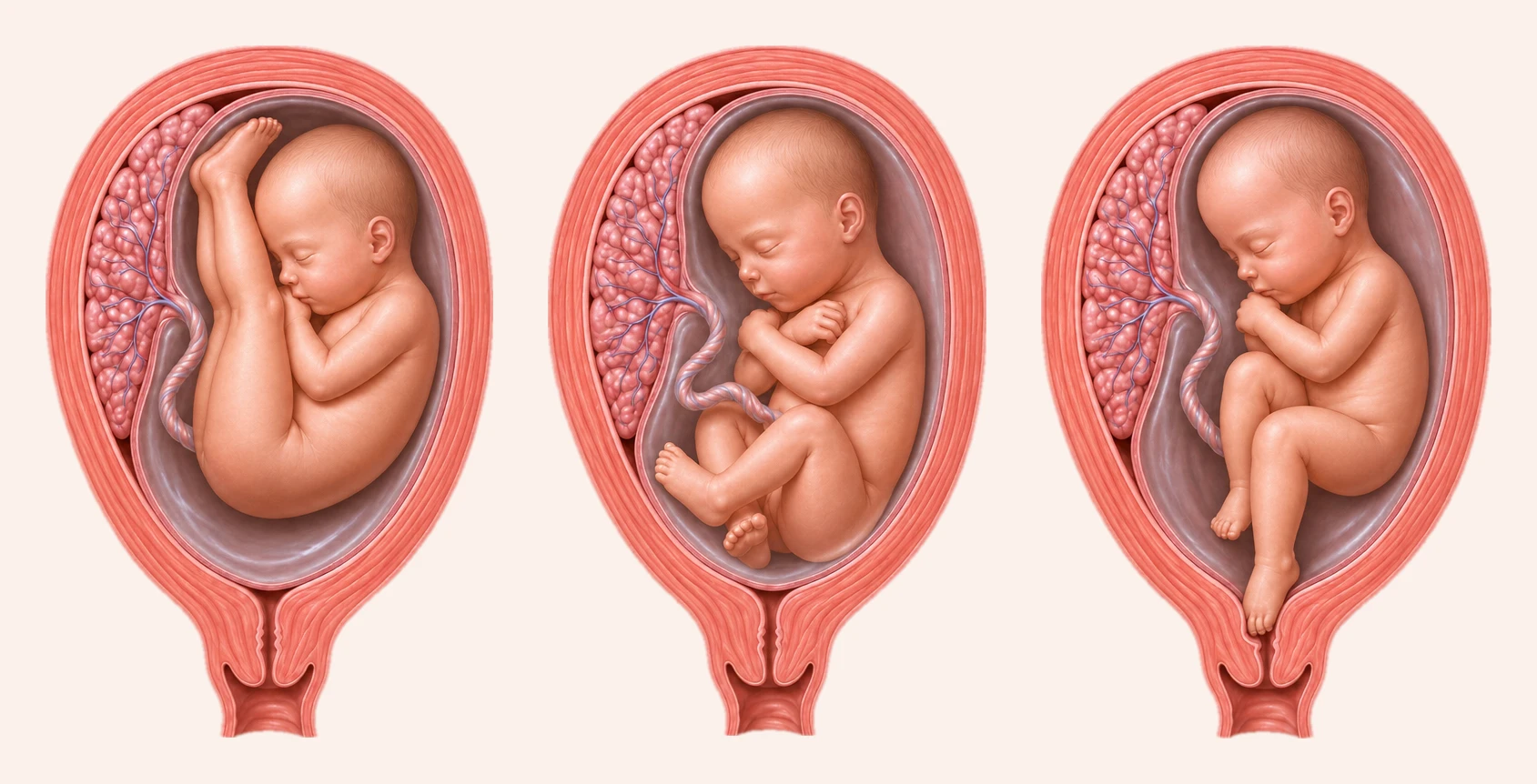
Sometimes the baby lies across the womb (transverse) or at an angle (oblique). These positions are less common and often change, but a baby cannot be born vaginally while lying across the womb.
How common is it?
The chance of your baby being breech depends on how many weeks pregnant you are, and it falls as your pregnancy approaches term, as most babies turn head down on their own. In our study of more than 100,000 women who had a routine scan at 35 to 37 weeks, the baby was not head down in about 6 in 100.
- At 28 weeks, about 25 in 100 babies are breech.
- At 35 to 37 weeks, this falls to about 6 in 100.
- At 39 to 40 weeks, it falls further to about 2 in 100.
Why does it happen?
Often there is no particular reason. It is normal for a baby to be breech earlier in pregnancy, as about 25 in 100 babies are breech at 28 weeks. A baby is more likely to stay breech when there is:
- a low-lying placenta (placenta praevia)
- a difference in the shape of the womb, such as a heart-shaped (bicornuate) womb or other less common differences in how the womb formed (Müllerian anomalies)
- reduced (oligohydramnios) or increased (polyhydramnios) amniotic fluid
- fibroids in the womb, particularly in the lower part of the womb
- a first pregnancy, in some cases.
Less often, breech can be linked to a condition affecting the baby’s nervous system or muscles, which is why a detailed assessment of your baby’s anatomy and growth is also carried out.
Will my baby turn on its own?
Many babies do. In our study, more than 4 in 10 babies who were not head down at the 36-week scan were head down at birth. About three quarters of these turned on their own, and about a quarter turned after ECV.
Babies are more likely to turn on their own in women who have had a baby before, when there is more fluid, and when the baby is lying across the womb rather than breech. They are less likely to turn in a first pregnancy or with a low-lying placenta. Because a breech baby may still turn, the position is usually checked again before any procedure or planned birth.
Occasionally, a baby who was head down at 36 weeks turns to breech later. In our study, this happened in about 3 in 1,000 pregnancies, which is why the position is also checked when labour starts.
What are my options?
If your baby is still breech at 36 to 37 weeks, your maternity team will discuss three main options with you:
| Option | What it involves | Main points to consider |
|---|---|---|
| External cephalic version (ECV) | A doctor or midwife gently turns your baby head down by pressing on your tummy, usually at 36 to 37 weeks | Works in about half of women; if successful, most women can plan a head-first birth |
| Planned caesarean birth | An operation to deliver your baby, usually planned at or after 39 weeks | Lowest risk for the baby around the time of birth, but the risks of an operation for you and future pregnancies |
| Planned vaginal breech birth | Labour and birth with your baby bottom or feet first, in a hospital with a team experienced in breech births | Avoids an operation; suitable for some women, after careful assessment |
External cephalic version (ECV)
ECV is usually offered from 36 weeks in a first pregnancy and from 37 weeks if you have had a baby before. It is carried out in a hospital maternity unit. A scan confirms your baby’s position, and your baby’s heart rate is checked before and after. You may be offered a medicine to relax the womb, which makes success more likely. The doctor or midwife then places their hands on your tummy and gently guides your baby to roll forwards or backwards into a head-down position.
How successful is it? ECV works in about half of women: about 4 in 10 in a first pregnancy and 6 in 10 in women who have had a baby before. In our study, it was successful in 44 in 100 women who had it. Once turned, fewer than 5 in 100 babies turn back to breech.
Is it safe? ECV is safe for most women and babies. It can be uncomfortable, and you can ask the team to stop at any time. Your baby’s heart rate may change for a short time afterwards, which usually settles quickly. About 1 in 200 women need an emergency caesarean birth straight after ECV, which is why it is done where this can be carried out quickly. If your blood group is rhesus negative, you will be offered an anti-D injection.
Who should not have ECV? ECV is not usually advised if you need a caesarean birth for another reason, if you have had bleeding in the last week, if your waters have broken, if you are expecting twins, if there are concerns about your baby’s heart rate, or if there is a major difference in the shape of your womb. It may also need extra care if your baby is small, there is little fluid or you have had a caesarean birth before.
If ECV is successful, most women go on to have a vaginal birth, although the chance of needing a caesarean or assisted birth is a little higher than for babies who were always head down.
Planned caesarean birth
If your baby stays breech, a caesarean birth is usually planned at or after 39 weeks, as babies born earlier are more likely to need help with their breathing. Your baby’s position is checked with a scan just before the operation, in case your baby has turned. If you go into labour before the planned date, you should go straight to your maternity unit.
A large international study, the Term Breech Trial, found that a planned caesarean birth reduced the risk of death or serious problems for the baby around the time of birth compared with a planned vaginal breech birth. The Royal College of Obstetricians and Gynaecologists (RCOG) estimates the risk of a baby dying around the time of birth as about 0.5 in 1,000 with a planned caesarean birth after 39 weeks, 2 in 1,000 with a planned vaginal breech birth and 1 in 1,000 with a planned head-first birth. Two years after birth, however, the Term Breech Trial found no difference in the health and development of the children.
A caesarean birth is a safe, common operation, but it carries the risks of surgery for you, such as infection, bleeding and blood clots, and a longer recovery. It can also affect future pregnancies, with a higher chance of problems with the placenta and of needing another caesarean birth.
Planned vaginal breech birth
Some women choose to have a vaginal breech birth, and for many it is a safe option when the right conditions are in place. It should be planned in a hospital with a team experienced in breech births, with continuous monitoring of your baby’s heart rate and the option of a caesarean birth if needed.
A vaginal breech birth is less likely to be advised when:
- there is another reason for a caesarean birth
- your baby’s head is tilted back (hyperextended neck)
- your baby is estimated to be large (above the 90th centile or more than 3.8 kg) or small (below the 10th centile)
- your baby is in a footling breech position
- you have had a caesarean birth before, as there is a higher risk of the scar opening
- a clinician experienced in vaginal breech birth is not available.
Your scan at 36 weeks helps with this decision, as it shows the type of breech, the position of your baby’s head, your baby’s estimated weight and the position of the placenta.
Is there anything I can do to help my baby turn?
You may read about positions and exercises, such as kneeling with your bottom raised, acupuncture or acupressure, or moxibustion, a traditional Chinese treatment where a herb is burned near the little toe. Some women choose to try acupuncture or acupressure, but there is not enough evidence that any of these help a breech baby to turn, and the RCOG does not recommend positions or exercises for this reason. They are unlikely to cause harm, but please talk to your midwife or doctor first, and do not delay a decision about ECV while you try them.
Whatever you decide, please contact your maternity unit straight away if your waters break, you have contractions or bleeding, or your baby is moving less than usual. With a breech baby, there is a higher chance of the umbilical cord slipping down when the waters break.
Frequently asked questions
Can my baby still turn after 36 weeks?
Yes. In our study, more than 4 in 10 babies who were not head down at the 36-week scan were head down at birth, most of them having turned on their own.
Does ECV hurt?
It can be uncomfortable, and some women find it painful. The procedure usually takes only a few minutes, and you can ask the team to stop at any time.
Is ECV safe for my baby?
Yes, for most babies. Your baby’s heart rate is checked before and after the procedure. About 1 in 200 women need an emergency caesarean birth straight after ECV, so it is done in a hospital where this can be carried out quickly.
Can I have ECV if I have had a caesarean birth before?
ECV can be considered after one previous caesarean birth. Your maternity team will discuss the benefits and risks with you.
When will my caesarean birth be planned?
Usually at or after 39 weeks. Your baby’s position is checked with a scan on the day, in case your baby has turned.
What if I go into labour before my planned caesarean birth or ECV?
Go straight to your maternity unit. Your baby’s position will be checked, and the team will discuss the safest way for your baby to be born.
Can I have a private scan alongside my NHS care?
Yes. Private scans are in addition to your NHS care, not instead of it. You will receive a written report to share with your midwife and maternity team.
Our approach at The Pregnancy Clinic
At The Pregnancy Clinic in Sevenoaks, Kent, late pregnancy scans are carried out by fetal medicine specialists. If your baby is breech, your scan includes:
- confirmation of your baby’s position and the type of breech
- the position of your baby’s head and neck
- your baby’s estimated weight and centile
- the position of the placenta and the amount of amniotic fluid
- a clear explanation of your options on the day, and a written report to share with your NHS maternity team, who can arrange ECV or plan your birth.
Book a 36-week scan
A consultant-led scan at 36 weeks confirms your baby’s position and checks growth, fluid and the placenta, to help you plan the safest birth.
Book a late pregnancy scan →The Pregnancy Clinic provides planned appointments only. If you have pain, bleeding, leaking fluid, reduced baby movements or any other urgent concern, please contact your local NHS maternity unit straight away, or call 999 in an emergency.
Related pregnancy guides
Clinical references
- De Castro H, Ciobanu A, Formuso C, Akolekar R, Nicolaides KH. Value of routine ultrasound examination at 35–37 weeks’ gestation in diagnosis of non-cephalic presentation. Ultrasound Obstet Gynecol 2020;55:248–256
- Fitiri M, Papavasileiou D, Mesaric V, Syngelaki A, Akolekar R, Nicolaides KH. Routine 36-week scan: diagnosis and outcome of abnormal fetal presentation. Ultrasound Obstet Gynecol 2025;65:154–162
- Hill LM. Prevalence of breech presentation by gestational age. Am J Perinatol 1990;7:92–3
- Hannah ME, Hannah WJ, Hewson SA, Hodnett ED, Saigal S, Willan AR. Planned caesarean section versus planned vaginal birth for breech presentation at term: a randomised multicentre trial. Lancet 2000;356:1375–83
- Impey LWM, Murphy DJ, Griffiths M, Penna LK, on behalf of the Royal College of Obstetricians and Gynaecologists. External cephalic version and reducing the incidence of term breech presentation. Green-top Guideline No. 20a. BJOG 2017;124:e178–e192
- Impey LWM, Murphy DJ, Griffiths M, Penna LK, on behalf of the Royal College of Obstetricians and Gynaecologists. Management of breech presentation. Green-top Guideline No. 20b. BJOG 2017;124:e151–e177
- Whyte H, Hannah ME, Saigal S, et al. Outcomes of children at 2 years after planned cesarean birth versus planned vaginal birth for breech presentation at term: the International Randomized Term Breech Trial. Am J Obstet Gynecol 2004;191:864–71
This guide provides general information and does not replace individual medical advice. Recommendations may vary according to your scan findings, pregnancy history and clinical circumstances.