
Being told that your baby is measuring big can raise many questions. Will labour be harder? Should I be induced? Will I need a caesarean section? Most large babies are healthy and are born without any problems. However, a large baby is more likely to have a difficult birth, and knowing about it before labour allows you and your maternity team to plan the safest birth.
This guide explains what large for gestational age (LGA) and fetal macrosomia mean, why some babies are large, how large babies are identified on scans, the risks during birth, and what the research, including our own studies, tells us about the best time for your baby to be born.
Key points
- A baby is described as large for gestational age (LGA) when the estimated weight is above the 90th centile for the stage of pregnancy.
- Fetal macrosomia describes a baby with a birth weight above 4 kg. Above 4.5 kg is described as severe macrosomia.
- Most large babies are healthy. The main concern is a higher chance of complications during labour and birth, particularly shoulder dystocia.
- Diabetes, a raised body mass index and a previous large baby are the most important risk factors.
- The 36-week scan identifies large babies much better than measuring the bump or a scan at 32 weeks.
- When a large baby is identified, you can make an informed choice about the timing and way of giving birth.
What does large for gestational age mean?
Your baby’s weight is estimated on a scan from measurements of the head, tummy and thigh bone, and is plotted on a growth chart as a percentile (commonly called a centile). A baby on the 50th centile is average in size for the stage of pregnancy.
- A baby whose estimated weight is above the 90th centile is described as large for gestational age (LGA). This means that 9 out of 10 babies at the same stage of pregnancy are smaller.
- A baby whose estimated weight is above the 95th centile is described as very large. National guidance in the UK uses this cut-off at or after 36 weeks to define a suspected large baby.
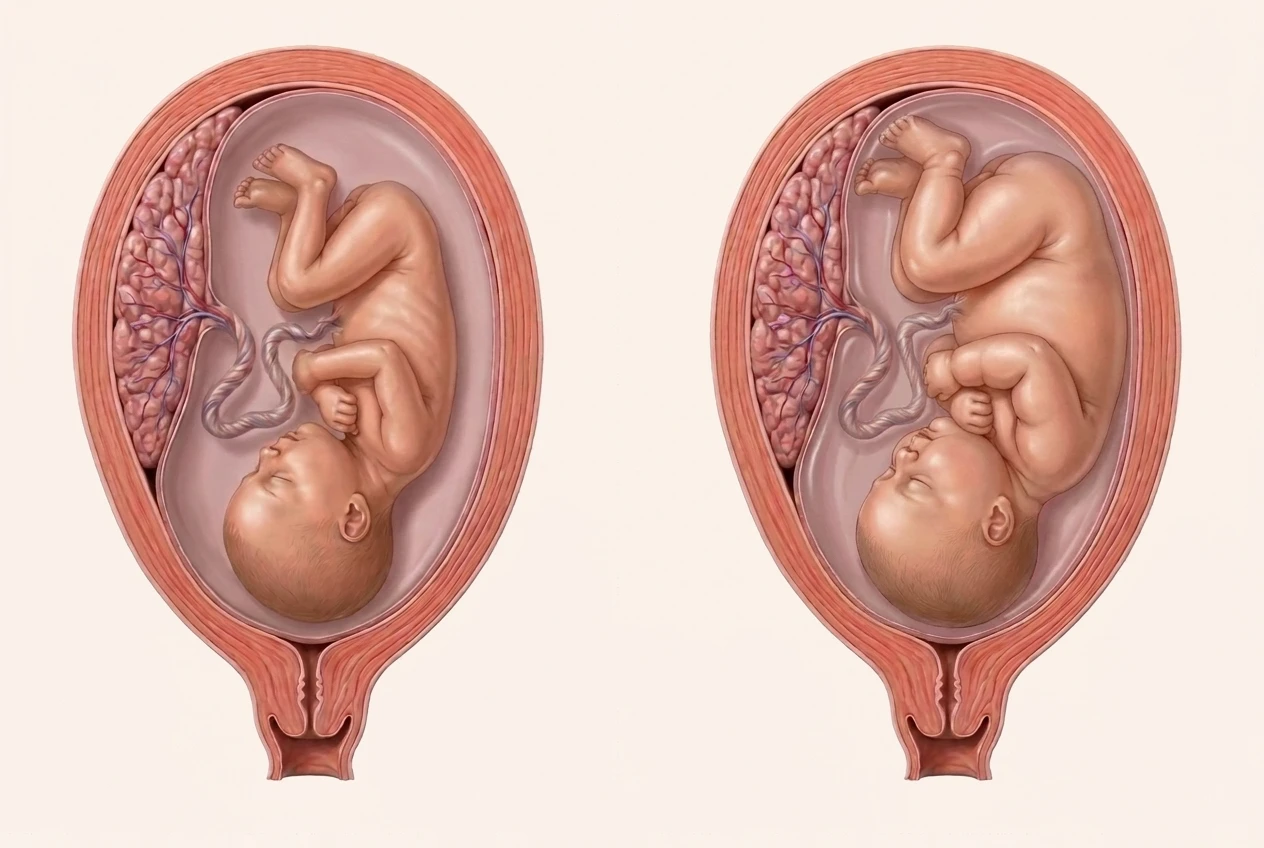
- Fetal macrosomia refers to the actual weight of the baby: a birth weight above 4 kg (about 8 lb 13 oz), and severe macrosomia above 4.5 kg (about 9 lb 15 oz).
LGA takes into account the stage of pregnancy, whereas macrosomia does not. In our study of more than 35,000 pregnancies, about 1 in 8 babies (12.7%) weighed more than 4 kg at birth, and about 1 in 55 (1.8%) weighed more than 4.5 kg.
© The Pregnancy Clinic
Constitutionally large or accelerated growth?
Not all large babies are the same. There are two main patterns:
| Constitutionally large baby | Accelerated growth | |
|---|---|---|
| Why the baby is large | Naturally large, often because the parents are tall or large | Growing faster than expected, most often because of diabetes or a raised body mass index |
| Growth pattern | Grows steadily along a high centile | Growth speeds up in the third trimester and the baby crosses centiles upwards |
| Body proportions | Head and body in proportion | The tummy (abdominal circumference) is often larger in proportion to the head |
| Amniotic fluid | Usually normal | May be increased (polyhydramnios) |
Babies with accelerated growth, particularly in pregnancies with diabetes, carry more of their extra weight around the tummy and shoulders. This is one reason why they are more likely to have shoulder dystocia at birth.
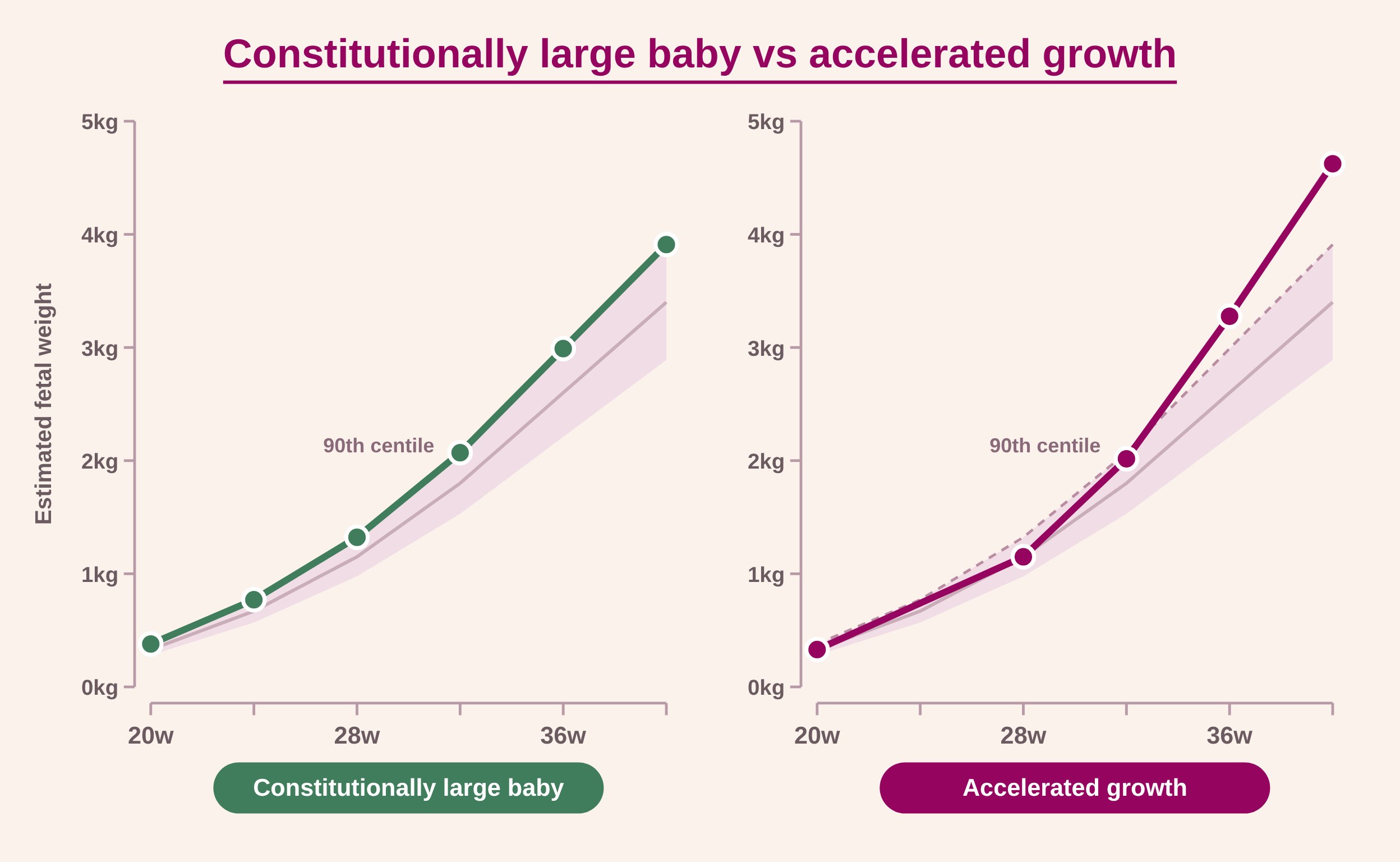
Illustration only. The shaded area shows the 10th to 90th centile.
© The Pregnancy Clinic
Why are some babies large?
The most common reasons are:
- constitutional size: some babies are large simply because their parents are tall or large, and they are otherwise healthy
- diabetes, either diabetes before pregnancy (type 1 or type 2) or gestational diabetes that develops during pregnancy. In our studies of more than 53,000 pregnancies, both pre-existing diabetes and gestational diabetes were independently associated with a higher chance of having a large baby
- a raised body mass index and excessive weight gain in pregnancy
- a previous large baby
- going past your due date, as babies continue to gain weight in the last weeks of pregnancy
- less often, rare genetic overgrowth conditions in the baby.
How is a large baby identified?
Measuring the size of your bump with a tape measure misses many large babies. An ultrasound scan in the third trimester is more accurate, and its timing matters.
In our research of more than 45,000 pregnancies, we found that:
- a scan at 36 weeks predicts a large baby much better than a scan at 32 weeks
- the estimated fetal weight is a better predictor than the measurement of the tummy alone
- an estimated weight above the 90th centile at 36 weeks identifies about 2 in 3 babies who are born with a birth weight above the 97th centile
- prediction is best for babies born within 10 days of the scan: about 8 in 10 of the largest babies (above the 97th centile) are identified.
Because babies continue to grow after the 36-week scan, the scan should be seen as a screening test rather than a diagnosis. We have proposed a two-stage approach: babies with an estimated weight above the 70th centile at 36 weeks can be offered a further scan at 38–39 weeks, and if at this stage the estimated weight is above the 90th centile, further options of birthing plans could be discussed.
You can read more in our guide The 36-Week Scan: What Does It Check and Why Does It Matter?
What other tests will I have?
If your baby measures large, the following help us understand why and plan your care:
- the amount of amniotic fluid, as increased fluid (polyhydramnios) is more common when a baby is large, particularly with diabetes
- your baby’s growth trajectory, comparing the measurements with any previous scans to see whether your baby is growing steadily or growth is speeding up
- the proportions of the head and tummy
- a test for gestational diabetes (glucose tolerance test), if you have not already had one, especially if your baby’s growth has speeded up or the fluid is increased
- a check of your baby’s anatomy and development to ensure there are no associated defects
- a check of your baby’s position.
What are the risks for me and my baby?
Most large babies are born safely. However, the chance of complications during labour and birth increases with the size of the baby. Our cohort study and our systematic review of the published research provide some of the most accurate estimates of these risks.
| Complication | Above 4 kg | Above 4.5 kg |
|---|---|---|
| Shoulder dystocia | About 10 times more likely | About 30 times more likely |
| Caesarean section because labour does not progress | About 3 times more likely | About 4 times more likely |
| Severe bleeding after birth | About 2 times more likely | About 3 times more likely |
| Third- or fourth-degree tear | About 2 times more likely | About 3 times more likely |
Birth weight above 4 kg and above 4.5 kg, compared with babies with an average birth weight between 2.5 and 4.0 kg. Based on our study of more than 35,000 pregnancies.
Complications for the baby are less common than complications for the mother. Most of them are related to shoulder dystocia, which happens when, after the baby’s head is born, one of the shoulders becomes stuck behind the mother’s pelvic bone. It is an emergency that midwives and doctors are trained to manage, and most babies are delivered safely. Uncommonly, the baby may have:
- an injury to the nerves that supply the shoulder and arm, causing weakness of the arm (brachial plexus injury). Most babies recover fully, but occasionally the weakness may be more long term
- a broken collarbone or upper arm bone (fracture of the clavicle or humerus), which usually heals well
- a lack of oxygen because of a delay in delivering the baby’s body, which can rarely lead to brain injury (hypoxic ischaemic encephalopathy)
- low blood sugar after birth (hypoglycaemia), particularly when the mother has diabetes. Babies of mothers with diabetes are also more likely to need admission to the neonatal unit after birth.
These complications are rare, but in our study they were considerably more common in babies weighing more than 4 kg, and more so above 4.5 kg.
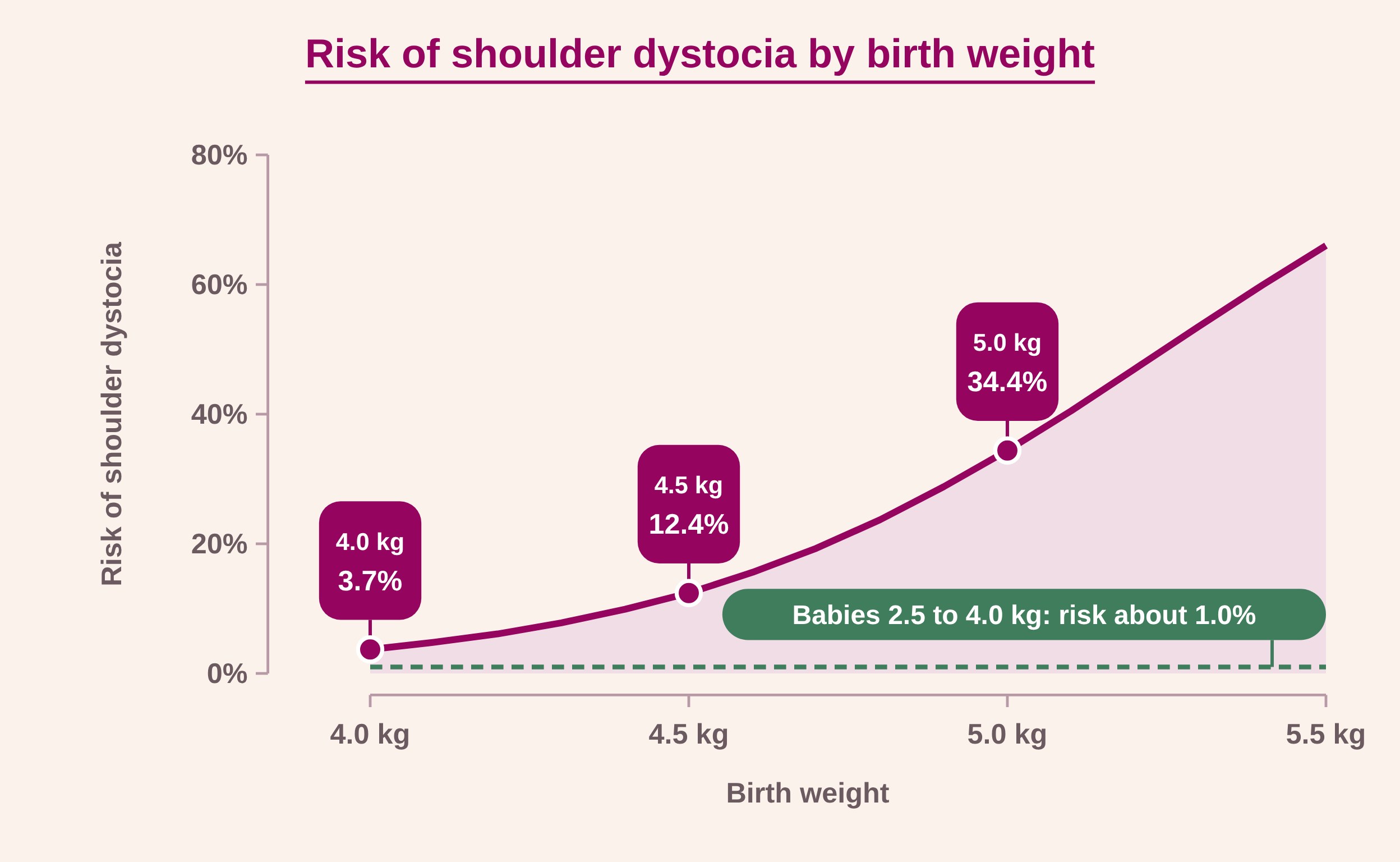
Percentage of babies who have shoulder dystocia at each birth weight.
Based on our study of more than 35,000 pregnancies.
© The Pregnancy Clinic
When and how should my baby be born?
There are three options when a baby is suspected to be large:
- waiting for labour to start naturally
- induction of labour (IOL)
- planned caesarean birth.
The national guidance recommends that the options are discussed with you, taking into account your individual circumstances and preferences, and that your decision is respected.
What the research shows
- In a randomised study of 822 women conducted on the management of big babies in several countries (France, Switzerland and Belgium), women with babies above the 95th centile were offered either IOL between 37 and 39 weeks or awaiting natural events. IOL reduced the combined risk of shoulder dystocia and related injuries, such as a fracture of the collarbone, by about two-thirds (8 compared with 25 babies). Babies in the IOL group were on average almost 300 g lighter at birth, women were more likely to have a vaginal birth without assistance, and there was no increase in caesarean births.
- A Cochrane review, which combined the results of four randomised studies including 1,190 women on the management of big babies, found that IOL at or near term reduced shoulder dystocia by about 40% and birth fractures by about 80%, and lowered the average birth weight by about 180 g, without increasing caesarean or assisted births.
- In the UK Big Baby trial, 2,893 women with a suspected large baby were offered either IOL at 38 weeks or standard care, awaiting natural events. In the analysis as originally intended (intention-to-treat analysis), shoulder dystocia occurred in 2.3% with IOL compared with 3.1% with standard care. This difference was not statistically significant, partly because many women in the standard care group also gave birth early: 25% had an IOL, a planned caesarean birth or went into labour by 38 weeks and 4 days, and 71% were eventually induced. When the analysis was limited to women who actually had an IOL at 38 weeks compared with those awaiting natural events beyond this time (per protocol analysis), shoulder dystocia was significantly reduced, from 3.7% to 2.3%.
- NICE notes that induction reduces the risk of shoulder dystocia, but increases the risk of a third- or fourth-degree tear.
Our research on the timing of birth
In our recent study of 7,695 large babies identified at the routine 36-week scan, we examined the chance of needing a caesarean section in labour because of concerns about the baby’s heart trace (fetal distress) or because labour did not progress (failure to progress). We found that:
- the risk increases progressively with each week of pregnancy, and rises more steeply after 40 weeks
- the risk is higher in a first pregnancy, and higher with induction than with labour that starts naturally
- the risk is higher when the estimated weight is above the 95th centile than between the 90th and 95th centile
- induction of labour after 41 weeks is associated with a substantially increased risk.
Based on these findings, the options for birth to consider are as follows:
| Finding at the 36-week scan | Options for birth to consider |
|---|---|
| Estimated weight above the 95th centile | Induction of labour at 38–39 weeks can be considered, after discussing the pros and cons of all management options |
| Estimated weight between the 90th and 95th centile | Induction of labour at 39–40 weeks can be considered, after discussing the pros and cons of all management options |
| Preferring to wait for labour to start naturally | Waiting until 41 weeks, with a planned caesarean birth if labour has not started by then, after discussing the pros and cons of all management options |
| Diabetes before or during pregnancy | Timing guided by your diabetes team, usually earlier, in line with national guidance on diabetes in pregnancy, after discussing the pros and cons of all management options |
A planned caesarean section may also be recommended in some situations, for example when the estimated weight is very high, particularly with diabetes, or if you have had a previous birth complicated by shoulder dystocia or a complicated caesarean birth. Your maternity team will discuss with you the best plan for your circumstances.
Can I reduce the chance of having a large baby?
Some of the risk factors for a large baby can be changed:
- if you have diabetes, good control of your blood sugar, before and during pregnancy, is the most important step
- a healthy, balanced diet and keeping active help to avoid excessive weight gain in pregnancy
- if you are found to have gestational diabetes, treatment with diet and, if needed, medication reduces the chance of your baby becoming large.
Our research has also looked at medications in pregnancy. In a randomised trial of metformin in women with a raised body mass index but without diabetes, metformin reduced weight gain in pregnancy but did not reduce the baby’s birth weight.
Frequently asked questions
Does a large estimated weight mean I will need a caesarean section?
No. Most women with a large baby have a vaginal birth. A caesarean section is one of the options, and is more likely to be recommended if the estimated weight is very high, if you have diabetes, or if you have had a previous birth complicated by shoulder dystocia.
How accurate is the estimated weight?
The estimated weight is usually within 10 to 15% of the actual birth weight. Some babies who measure large on a scan are born at a normal weight, and some babies who measure normally are born large. This is why the 36-week scan is a screening test, and a further scan may be offered.
Is a large baby the same as macrosomia?
Not quite. Large for gestational age means the estimated weight is above the 90th centile for the stage of pregnancy. Macrosomia refers to a birth weight above 4 kg, whatever the stage of pregnancy.
Did I do something to cause my baby to be large?
In most cases, no. Many large babies are large because their parents are tall or large. Diabetes and a raised body mass index increase the chance of a large baby, and good blood sugar control and a healthy lifestyle can help.
Should I be tested for gestational diabetes?
If your baby is measuring large, has speeded up in growth, or there is increased fluid, a glucose tolerance test is usually recommended if you have not had one already.
Can I wait for labour to start naturally?
Yes. This is your choice. Our research suggests that the risks increase after 40 weeks, and that induction after 41 weeks carries a higher risk of caesarean section. If you prefer to wait, a planned caesarean section at 41 weeks may be discussed if labour has not started.
Should I monitor my baby’s movements?
Yes. Please contact your maternity unit straight away if your baby’s movements slow down, change or stop. Do not wait until the next day, and do not rely on a home heartbeat monitor.
Can I have a private growth scan alongside my NHS care?
Yes. Private scans are in addition to your NHS care, not instead of it. You will receive a written report to share with your midwife and maternity team.
Our approach at The Pregnancy Clinic
At The Pregnancy Clinic in Sevenoaks, Kent, growth scans are carried out by fetal medicine specialists. If your baby measures large, your scan includes:
- your baby’s estimated weight and centile, and your baby’s growth trajectory if you have had earlier scans
- the amount of amniotic fluid
- your baby’s position, and a check of the anatomy and the placenta
- Doppler blood flow to assess your baby’s wellbeing
- a clear explanation on the day of the options for the timing and way of birth, and a written report with recommendations to share with your NHS maternity team.
Book a growth and Doppler scan
A consultant-led growth and Doppler scan at 36 weeks gives you a clear picture of your baby’s size and wellbeing, and helps you make an informed choice about your birth.
Book a growth and Doppler scan →The Pregnancy Clinic provides planned appointments only. If you have pain, bleeding, leaking fluid, reduced baby movements or any other urgent concern, please contact your local NHS maternity unit straight away, or call 999 in an emergency.
Related pregnancy guides
Clinical references
- Beta J, Khan N, Fiolna M, Khalil A, Ramadan G, Akolekar R. Maternal and neonatal complications of fetal macrosomia: cohort study. Ultrasound Obstet Gynecol 2019;54:319–325
- Beta J, Khan N, Khalil A, Fiolna M, Ramadan G, Akolekar R. Maternal and neonatal complications of fetal macrosomia: systematic review and meta-analysis. Ultrasound Obstet Gynecol 2019;54:308–318
- Khan N, Ciobanu A, Karampitsakos T, Akolekar R, Nicolaides KH. Prediction of large-for-gestational-age neonate by routine third-trimester ultrasound. Ultrasound Obstet Gynecol 2019;54:326–333
- Karkia R, Giacchino T, Shah S, Gough A, Ramadan G, Akolekar R. Gestational diabetes mellitus: association with maternal and neonatal complications. Medicina (Kaunas) 2023;59:2096
- Karkia R, Giacchino T, Watson H, Gough A, Ramadan G, Akolekar R. Maternal and neonatal complications in pregnancies with and without pre-gestational diabetes mellitus. J Perinat Med 2023;52:30–40
- Syngelaki A, Nicolaides KH, Balani J, Hyer S, Akolekar R, Kotecha R, Pastides A, Shehata H. Metformin versus placebo in obese pregnant women without diabetes mellitus. N Engl J Med 2016;374:434–443
- Boulvain M, Senat MV, Perrotin F, et al. Induction of labour versus expectant management for large-for-date fetuses: a randomised controlled trial. Lancet 2015;385:2600–2605
- Boulvain M, Thornton JG. Induction of labour at or near term for suspected fetal macrosomia. Cochrane Database Syst Rev 2023;3:CD000938
- Gardosi J, et al. Induction of labour versus standard care to prevent shoulder dystocia in fetuses suspected to be large for gestational age in the UK (the Big Baby trial). Lancet 2025
- Farina A, Cavoretto PI, Syngelaki A, Mitrogiannis I, Akolekar R, Nicolaides KH. Routine 36-week scan: optimizing delivery timing of large for gestational age fetuses. Am J Obstet Gynecol 2026;235:385–394
- National Institute for Health and Care Excellence. Inducing labour (NICE guideline NG207). 2021, updated 2023
This guide provides general information and does not replace individual medical advice. Recommendations may vary according to your scan findings, pregnancy history and clinical circumstances.