
Your estimated due date is usually first worked out from the first day of your last menstrual period. Ultrasound scans then check whether your baby's size is consistent with those dates.
In most pregnancies, the dating of the pregnancy is confirmed at the 11 to 14-week scan, by measuring the baby's crown–rump length.
Key points
- Pregnancy dating is generally confirmed at the 11 to 14-week scan, by measuring the baby's crown–rump length (CRL).
- An early pregnancy scan checks that the baby's measurements are consistent with your period dates.
- If your cycles are irregular or you do not know the exact date of your last period, the pregnancy is initially dated by an early pregnancy ultrasound scan and then confirmed at the 12-week scan for a final estimation of the due date.
- In IVF and ICSI pregnancies, dating is very precise because the date of conception is known.
- Only a small minority of babies arrive on their due date. A baby born from 37 weeks is classed as term.
Dating from your period
Dating from your last period assumes that every cycle is 28 days long, with ovulation and conception on day 14. This is not always the case. Even in women with regular cycles, ovulation, and then conception and implantation, can occur anywhere from around day 12 to day 16 of the cycle.
That is why dating from period dates alone has a greater margin of error than dating by ultrasound. Therefore, the most accurate dating is by ultrasound, by measuring the baby's crown–rump length at 11 to 14 weeks.
What does an early scan show?
An early pregnancy scan is a good way to confirm that the baby's measurements are consistent with your period dates.
- If the scan and your period dates broadly agree, your dates are kept as they are until the 11 to 14-week scan, when the pregnancy is dated precisely.
- If your dates are unreliable or not known, for example because your cycles are irregular or you are unsure of the date of your last period, the pregnancy is dated by ultrasound: by the size of the pregnancy sac at a very early stage, and by the baby's crown–rump length once the baby can be seen.
For further information, read: What Can You See on a Pregnancy Scan at 5, 6, 7 and 8 Weeks?
Dating in the first trimester
At 11 to 14 weeks, the baby's crown–rump length, the length from the top of the head to the bottom, is measured. When the crown–rump length is between 45 and 84 mm, this is the most accurate way to date a pregnancy, usually to within about 5 days.
Once the pregnancy has been dated at this scan, the due date is not normally changed at later scans. If the baby measures larger or smaller later in pregnancy, this reflects the baby's growth rather than a change in dates. Accurate dating is therefore important, because the baby's growth is always assessed against the gestational age.
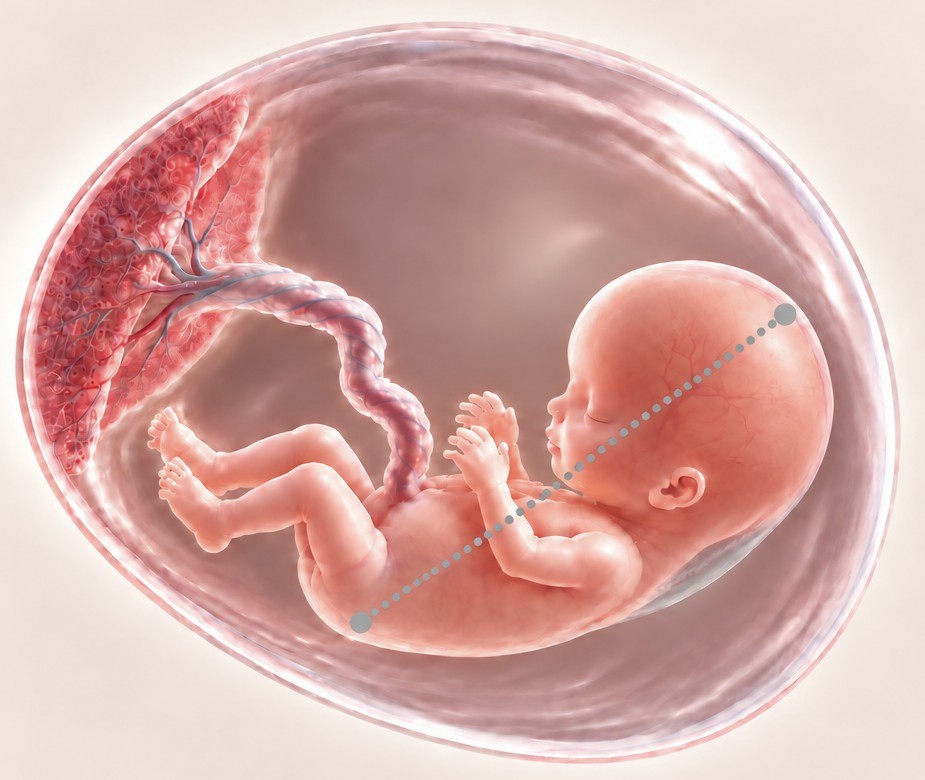
Crown–rump length by gestational age
© The Pregnancy Clinic
Dating in IVF and ICSI pregnancies
In IVF and ICSI pregnancies, dating is very precise because the exact date of conception is known. This makes it straightforward to calculate the gestational age and estimated due date, from the date of egg collection or embryo transfer and the age of the embryo, for example a day 3 embryo or a day 5 blastocyst.
What is the estimated due date and how is it calculated?
The estimated due date is traditionally calculated using Naegele's rule, which adds 280 days (40 weeks) to the first day of your last period. This is a fairly old method of estimating the length of human pregnancy, developed in the 1800s, and the 40-week due date is only a rough guide. Only a small minority of babies actually arrive on their due date.
The more important milestone is 37 weeks. Labour that starts, and a baby born, from 37 weeks onwards is classed as a term pregnancy and delivery.
Related pregnancy guides
Frequently asked questions
How is my due date worked out?
Your due date is first estimated from the first day of your last period by adding 280 days (40 weeks). It is then checked by ultrasound, and the pregnancy is dated precisely at the 11 to 14-week scan.
Will my due date change after my scan?
If an early scan broadly agrees with your period dates, your dates are kept until the 11 to 14-week scan, which sets the final due date. After that, the due date is not normally changed.
Why might my period dates not match my scan?
Dating from your period assumes a 28-day cycle with ovulation on day 14. Even in women with regular cycles, ovulation, conception and implantation can occur anywhere from around day 12 to day 16.
How accurate is a dating scan?
At 11 to 14 weeks, measuring the baby's crown–rump length dates the pregnancy to within about 5 days.
How are IVF and ICSI pregnancies dated?
Dating is very precise because the exact date of conception is known. The due date is calculated from the date of egg collection or embryo transfer, taking into account the age of the embryo.
Will my baby arrive on my due date?
Only a small minority of babies arrive on their due date. A baby born from 37 weeks is classed as term.
Early pregnancy scans at The Pregnancy Clinic
At The Pregnancy Clinic, early pregnancy scans are provided as part of a consultant-led pregnancy and fetal medicine service. Your scan measurements are checked against your period dates, and you will be told whether your dates are consistent or whether the pregnancy should be dated by ultrasound.
Book an early pregnancy scan →The Pregnancy Clinic is not an emergency service. If you have severe pain, heavy bleeding, fainting or other acute symptoms, please seek urgent NHS assessment.
Clinical references
- Robinson HP, Fleming JE. A critical evaluation of sonar “crown-rump length” measurements. Br J Obstet Gynaecol 1975;82:702–10
- Nicolaides KH, Wright D, Syngelaki A, Wright A, Akolekar R. Fetal Medicine Foundation fetal and neonatal population weight charts. Ultrasound Obstet Gynecol 2018;52:44–51
- NICE — Antenatal care (NG201)
- The Fetal Medicine Foundation