Assessment of the right subclavian artery is a specialist assessment and is not part of every routine 20-week scan. It is usually assessed during a specialist fetal medicine scan or a fetal echocardiogram (a detailed scan of the baby’s heart), or when your sonographer is carrying out a particularly thorough detailed scan. A detailed assessment of the heart looks not only at the main chambers of the heart, but also at the blood vessels leaving and entering the heart.
The aorta is one of the main blood vessels leaving the heart. One of its first branches is the right subclavian artery, which supplies blood to the right arm. Usually, it arises from the aorta, passes in front of the windpipe and enters the right arm. This is a normal right subclavian artery. In some babies, the right subclavian artery follows an unusual course and passes behind the windpipe. This is called an aberrant right subclavian artery, often shortened to ARSA.
In most babies, an aberrant right subclavian artery is a normal variation in the way the blood vessels have formed. It does not affect the heart or the blood supply to the arm, and most people with it never know they have it.
When it is present on its own, as an isolated finding, with a low-chance screening result, it does not need any further tests. A careful review of the rest of the scan and your earlier screening results confirms that it is isolated.
Key points
- An aberrant right subclavian artery (ARSA) is a variation in the route of the artery that supplies the right arm.
- It is seen in about 1 in 100 healthy babies and is the most common variation of the blood vessels around the heart.
- It does not affect the heart, the blood supply to the arm or the baby’s growth and development.
- As an isolated finding, with a low-chance result from combined screening or NIPT, it is considered a normal variation and no further tests are needed.
- It is more common in babies with Down’s syndrome, but in these babies there are almost always other findings on the scan.
- A detailed check of the baby’s heart is important, as ARSA is occasionally seen together with a heart condition.
- Almost all babies with an isolated ARSA have no symptoms after birth.
What is an aberrant right subclavian artery?
The aorta is the main artery that carries blood from the heart to the body. As it leaves the heart, it curves over in an arch, and several branches arise from the top of this arch to supply the head and arms. The subclavian arteries supply blood to the arms.
The right subclavian artery, which supplies the right arm, arises from the arch of the aorta as one of its first branches. When it is aberrant, it arises as the last branch of the arch instead of one of the first, and passes behind the windpipe (trachea) and the food pipe (oesophagus) to reach the right arm.
“Aberrant” simply means that it follows a different route. The artery is normal in size and carries blood to the right arm in the usual way.
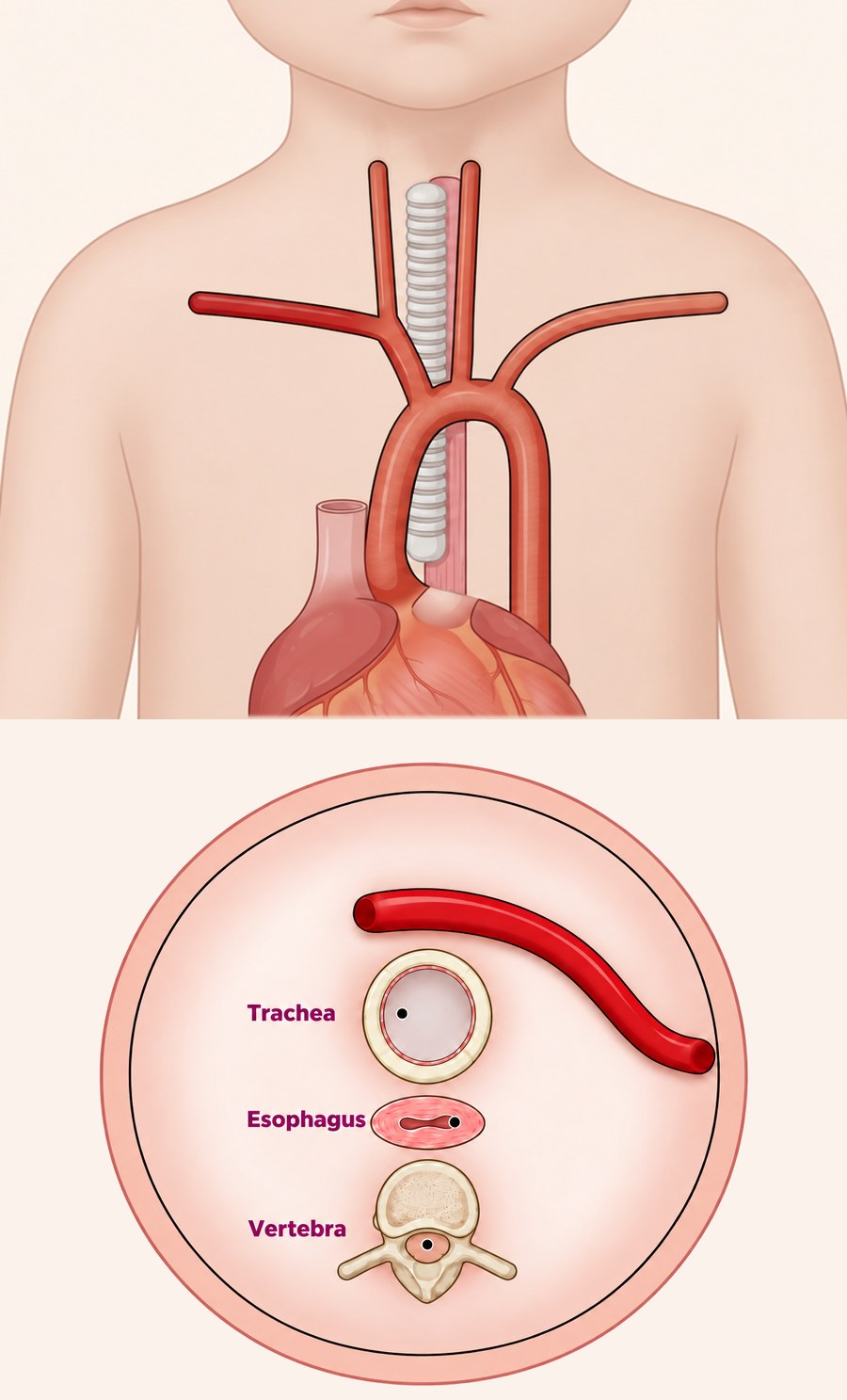 Normal right subclavian artery
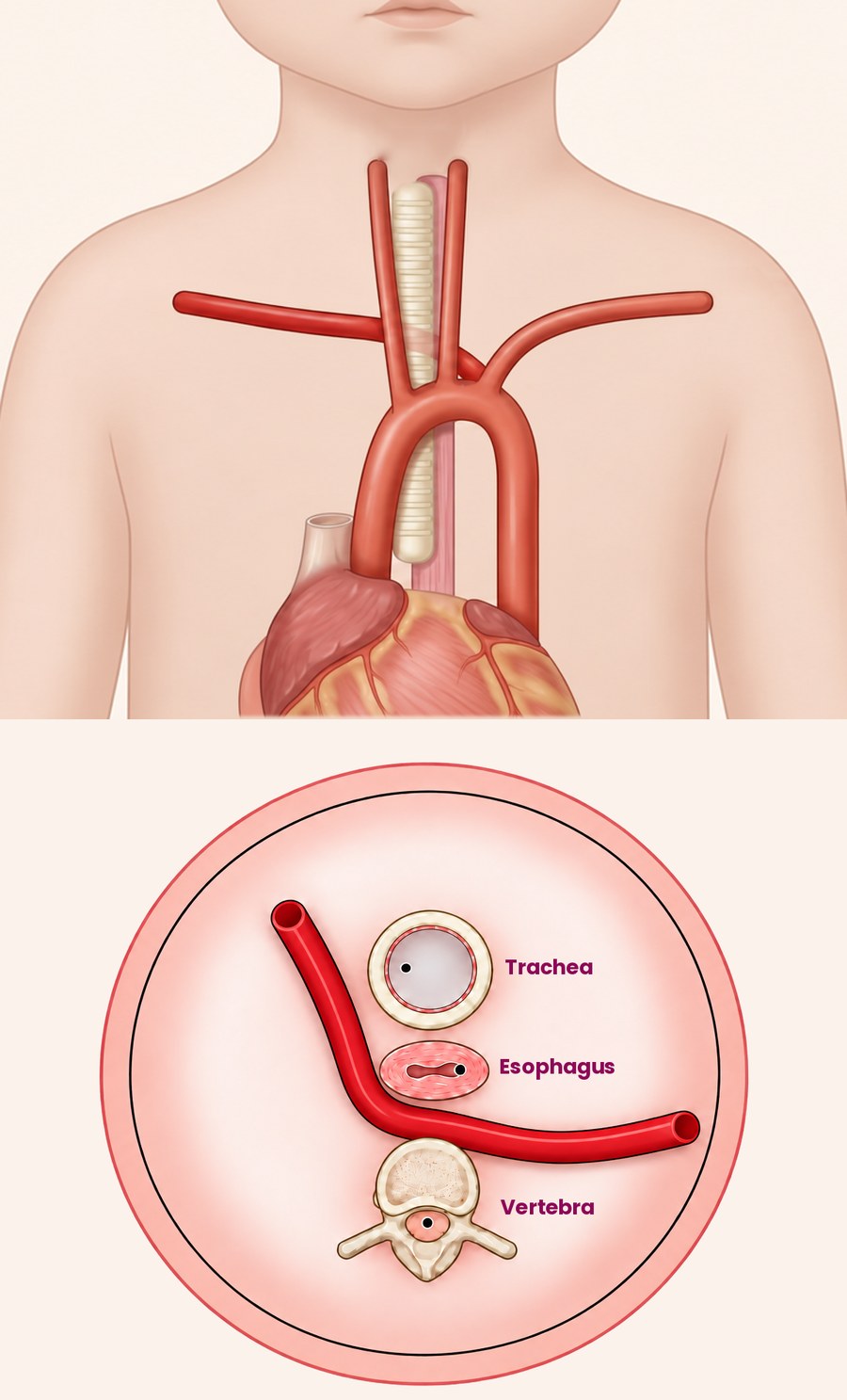 Aberrant right subclavian artery
© The Pregnancy Clinic
How common is it?
An aberrant right subclavian artery is found in about 1 in 100 healthy babies, and in a similar proportion of adults. It is the most common variation of the arch of the aorta. Most people with it go through life without ever knowing.
Is an isolated ARSA of any significance?
No. When an aberrant right subclavian artery is seen on its own, without any other structural or anatomical abnormality, and with a low-chance result from combined screening in the first trimester or from NIPT, it is considered a normal variation of the blood vessels and is of no clinical significance.
In these pregnancies, no further tests, such as an amniocentesis, are needed because of the ARSA.
Does it affect my baby’s heart?
No. The aberrant right subclavian artery itself does not affect how the heart works. However, it is occasionally seen together with a heart condition, so a detailed assessment of your baby’s heart is important.
This includes a careful check of the four chambers of the heart, the valves, the large blood vessels leaving the heart and the arch of the aorta. If the rest of the heart is normal, no further heart scans are usually needed because of the ARSA.
Is it linked to Down’s syndrome or other genetic conditions?
An aberrant right subclavian artery is more common in babies with Down’s syndrome than in other babies. However, in babies with Down’s syndrome there are almost always other findings on the scan or a high-chance result from combined screening. When ARSA is the only finding and screening was low chance, it does not increase the chance of Down’s syndrome.
Rarely, ARSA is seen in babies with a small missing piece of chromosome 22, called 22q11.2 deletion. This is almost always seen together with a heart condition or other findings, rather than with an isolated ARSA.
A holistic fetal medicine review is essential. This includes a detailed assessment of your baby’s anatomy and heart, a careful check for any other associated markers, and a review of your first-trimester chance of Down’s syndrome from combined screening. If you have had NIPT, this result is also taken into account. If you have not had screening, or other findings are seen, we will discuss whether NIPT or a diagnostic test would be helpful.
For further information, read: Genetic Markers and Soft Markers at the 20-Week Scan
What happens next?
What is recommended depends on the whole picture, not on the ARSA alone. As a general guide:
| Situation | What it usually means | Usual next step |
|---|---|---|
| Isolated ARSA, low-chance combined screening or NIPT | A normal variation of the blood vessels | No further tests are needed |
| Isolated ARSA, no earlier screening | Very likely a normal variation | Discussion of NIPT or amniocentesis for reassurance |
| ARSA with a heart condition, other markers or structural findings | A higher chance of a chromosomal or genetic condition | Specialist fetal medicine review, detailed heart scan and discussion of amniocentesis |
If an amniocentesis is offered, the sample is usually tested with a detailed chromosome test called a microarray, which can also detect a 22q11.2 deletion.
An isolated ARSA does not change how or where you give birth, and you can give birth at your local maternity unit.
What happens after birth?
Almost all babies with an isolated aberrant right subclavian artery have no symptoms and need no treatment or special checks after birth.
Because the artery passes behind the food pipe and windpipe, it can very rarely press on them. Later in life, this may occasionally cause difficulty swallowing solid food, or noisy breathing in a young child. If your child ever has persistent problems with swallowing or breathing, it is helpful to mention to your doctor that an ARSA was seen before birth.
Frequently asked questions
Did I do something to cause this?
No. An aberrant right subclavian artery is a variation in how the blood vessels form early in pregnancy. It is not caused by anything you have eaten, drunk or done.
Is ARSA a heart defect?
No. It is a variation in the route of an artery, not a problem with the heart itself. A detailed check of the heart is still recommended to make sure the rest of the heart is normal.
Will it go away?
No. The artery stays in the same position, but this does not matter. Most people with an ARSA never know they have it.
Do I need an amniocentesis?
Not usually. When ARSA is an isolated finding and your earlier screening was low chance, a diagnostic test is not recommended. It may be discussed if a heart condition or other findings are seen.
Will my baby need a heart scan after birth?
Not usually. If the heart was normal on the detailed scan in pregnancy, no routine heart scan is needed after birth because of an isolated ARSA. Your paediatric team may advise otherwise if there are other findings.
Our approach at The Pregnancy Clinic
At The Pregnancy Clinic in Sevenoaks, Kent, detailed scans are carried out by fetal medicine specialists. If an aberrant right subclavian artery is seen, our approach includes:
- a detailed assessment of your baby’s heart, including the arch of the aorta and its branches
- a careful check of the rest of your baby’s anatomy for any other associated markers
- a review of your earlier combined screening or NIPT results
- a clear explanation of the findings on the day, including whether any further tests would be helpful
- a written report to share with your NHS maternity team.
Book a detailed scan
If an aberrant right subclavian artery was seen at your scan and you would like a specialist review, a detailed anomaly scan with a fetal medicine specialist includes a careful assessment of your baby’s heart.
Book a detailed anomaly scan →The Pregnancy Clinic provides planned appointments only. If you have pain, bleeding, leaking fluid, reduced baby movements or any other urgent concern, please contact your local NHS maternity unit straight away, or call 999 in an emergency.
Related pregnancy guides
Clinical references
- Scala C, Leone Roberti Maggiore U, Candiani M, et al. Aberrant right subclavian artery in fetuses with Down syndrome: a systematic review and meta-analysis. Ultrasound Obstet Gynecol 2015;46:266–76
- De León-Luis J, Gámez F, Bravo C, et al. Second-trimester fetal aberrant right subclavian artery: original study, systematic review and meta-analysis of performance in detection of Down syndrome. Ultrasound Obstet Gynecol 2014;44:147–53
- Montero Carreras C, Cortés Olivera B, Saiz-Vivó R, et al. Aberrant right subclavian artery: the importance of distinguishing between isolated and non-isolated cases in prenatal diagnosis and clinical management. J Perinat Med 2025;53:394–401
- Morlando M, Morelli C, Del Gaizo F, et al. Aberrant right subclavian artery: the association with chromosomal defects and the related post-natal outcomes in a third level referral centre. J Obstet Gynaecol 2022;42:239–43
- Goldmuntz E, Bassett AS, Boot E, et al. Prenatal cardiac findings and 22q11.2 deletion syndrome: fetal detection and evaluation. Prenat Diagn 2024;44:804–14
This guide provides general information and does not replace individual medical advice. Recommendations may vary according to your scan findings, pregnancy history and clinical circumstances.